Let’s talk about how we can build your commerce project — tailored to your business, powered by Rigby
If you plan to build or grow a B2B marketplace in 2026, you need more than a catalog and checkout. Modern B2B marketplace platforms need to support multi-vendor logistics, complex account structures, flexible payment terms, procurement workflows, and strict compliance.
Without these building blocks, a marketplace struggles to onboard enterprise buyers and large suppliers, even if the UI looks polished.
In this article, we’ll walk you through 7 core features your business-to-business marketplace should cover:
- vendor onboarding,
- procurement workflows,
- payment terms and financing,
- account hierarchies and role management,
- fulfillment and logistics integration,
- compliance and governance,
- analytics and insights.
Understanding how these areas work will help you shape your roadmap, talk clearly with stakeholders, and make concrete decisions about marketplace development for your own B2B platform.
Check out our other article if you’re looking for a detailed breakdown of features required in a B2C marketplace.
Key insights
- Enterprise marketplaces that run for more than a year typically record a minimum 10% uplift in digital revenue, mainly due to a broader assortment enabled by external sellers.
- About 75% of B2B firms with complex structures say that structured account hierarchies are necessary to scale their digital commerce in a controlled way.
- Large marketplaces frequently deliver orders faster and negotiate better shipping prices than standalone contracts, because they rely on optimized logistics and aggregated shipping volumes.
- B2B companies that actively apply analytics in sales and marketing are around 1.5x more likely to achieve above-average results compared to their competitors.
- The core decision in marketplace development is choosing an architecture that can handle complex B2B operations.
What is B2B marketplace?
A B2B marketplace is an online platform where companies buy and sell products or services to each other.
Unlike a traditional online store, a marketplace connects multiple independent sellers with multiple business buyers. Each seller manages their own catalog, availability, pricing rules, and fulfillment process, while the marketplace operator focuses on infrastructure, governance, and buyer experience.
A B2B marketplace online typically supports:
- contract pricing per customer,
- purchase orders and payment terms,
- roles and approval chains inside buyer organizations,
- large order volumes and freight shipping,
- seller onboarding, compliance checks, and catalog management.
B2B (business-to-business) vs. B2C (business-to-consumer) marketplaces: 4 differences
Although both models rely on multi-vendor commerce, the mechanics behind business to business and business to consumer marketplace differ significantly.
1. Buying process
Both B2B and B2C marketplaces connect many sellers with many buyers, but the buying mechanics are very different.
In a B2B marketplace, a single order often involves several stakeholders: requesters, supply chain managers, finance, and procurement professionals. Purchases pass through approvals, budget checks, and internal policies.
In B2C, potential customers usually decide alone and complete a simple checkout without internal review.
2. Pricing & payments
B2B transactions rely on contract-based pricing, volume breaks, and negotiated terms that can differ per customer or even per account branch.
B2C pricing is usually public, uniform, and visible to everyone.
Payments follow the same pattern: B2B buyers expect net 30 or net 60 terms, purchase orders, credit lines, and sometimes multi-stage payments tied to milestones. B2C shoppers pay instantly with cards or digital wallets.
3. Accounts
A B2B marketplace needs to reflect real organizations: parent companies, subsidiaries, departments, and users with specific roles and permissions.
In contrast, B2C platforms normally map one person to one account.
4. Logistics
On the logistics side, B2B orders often mean freight, LTL shipping, pallets, recurring orders, and scheduled deliveries to docks or warehouses.
B2C orders are smaller, parcel-based, and follow a simpler tracking flow.
These differences directly influence how B2B marketplace platforms are built and why they require more advanced workflows.
Types of business-to-business marketplace
B2B marketplaces can be grouped in several ways, depending on their industry focus, revenue model, or market structure.
Understanding these categories helps you position your own platform and decide which features matter most during marketplace development.
Based on industry focus
Vertical marketplaces
A vertical marketplace focuses on a single industry or product category. Examples include platforms for construction materials, industrial components, medical supplies, automotive parts, or agricultural products.
These marketplaces usually go deeper into domain-specific requirements such as certifications, compliance checks, freight rules, or highly technical product attributes.
A vertical model works well when buyers need specialized assortments and suppliers require precise catalog structures.
Horizontal marketplaces
A horizontal marketplace spans multiple industries and offers broad assortments across many categories.
This model is often used for indirect procurement, office supplies, maintenance products, or general business goods. Buyers join because they can centralize long-tail spend in one place instead of managing hundreds of small independent retailers.
Horizontal platforms tend to prioritize international buyers, catalog standardization, search accuracy, and procurement workflows rather than deep industry-specific features.s
Based on the business model
Commission-based
The marketplace operator takes a percentage of every completed transaction. This model aligns revenue with GMV and is common in wholesale, distribution, and general multi-vendor commerce.
Subscription-based
Sellers, and sometimes buyers, pay a recurring monthly or annual fee to access the platform. This model is used when the marketplace provides tools, infrastructure, or data services that companies rely on regularly, regardless of transaction volume.
Listing fee-based
Sellers pay for creating product listings, boosting visibility, or running advertisements within the marketplace. This model suits platforms that handle high catalog volume or offer strong demand generation for suppliers.
Based on market structure
Local vs. global marketplace
Some marketplaces operate in a defined geography – one country, region, or supply zone – where logistics, tax rules, and regulations are consistent.
Others operate in a global network and accommodate cross-border shipping, currency handling, compliance checks, and international seller onboarding.
Many-to-many
Multiple global buyers and multiple sellers trade on the same platform. This structure represents the classic marketplace model and typically requires robust onboarding tools, pricing rules, account hierarchies, and multi-vendor order handling.
One-to-many
A single seller or distributor is offering basic services or products to many business buyers. Although technically still a marketplace architecture, the focus shifts to catalog scale, contract pricing, and procurement workflows rather than multi-vendor orchestration.
Procurement (RFQ) marketplaces
In this reverse model, buyers post requirements – specifications, quantities, delivery deadlines – and suppliers respond with bids or quotes. This structure is common in construction, manufacturing, facilities management, and other categories where orders are high-value, customized, or project-based.
4 examples of successful B2B marketplaces
Below are well-known and widely referenced examples showing you how different marketplace models operate in practice:
1. Alibaba.com
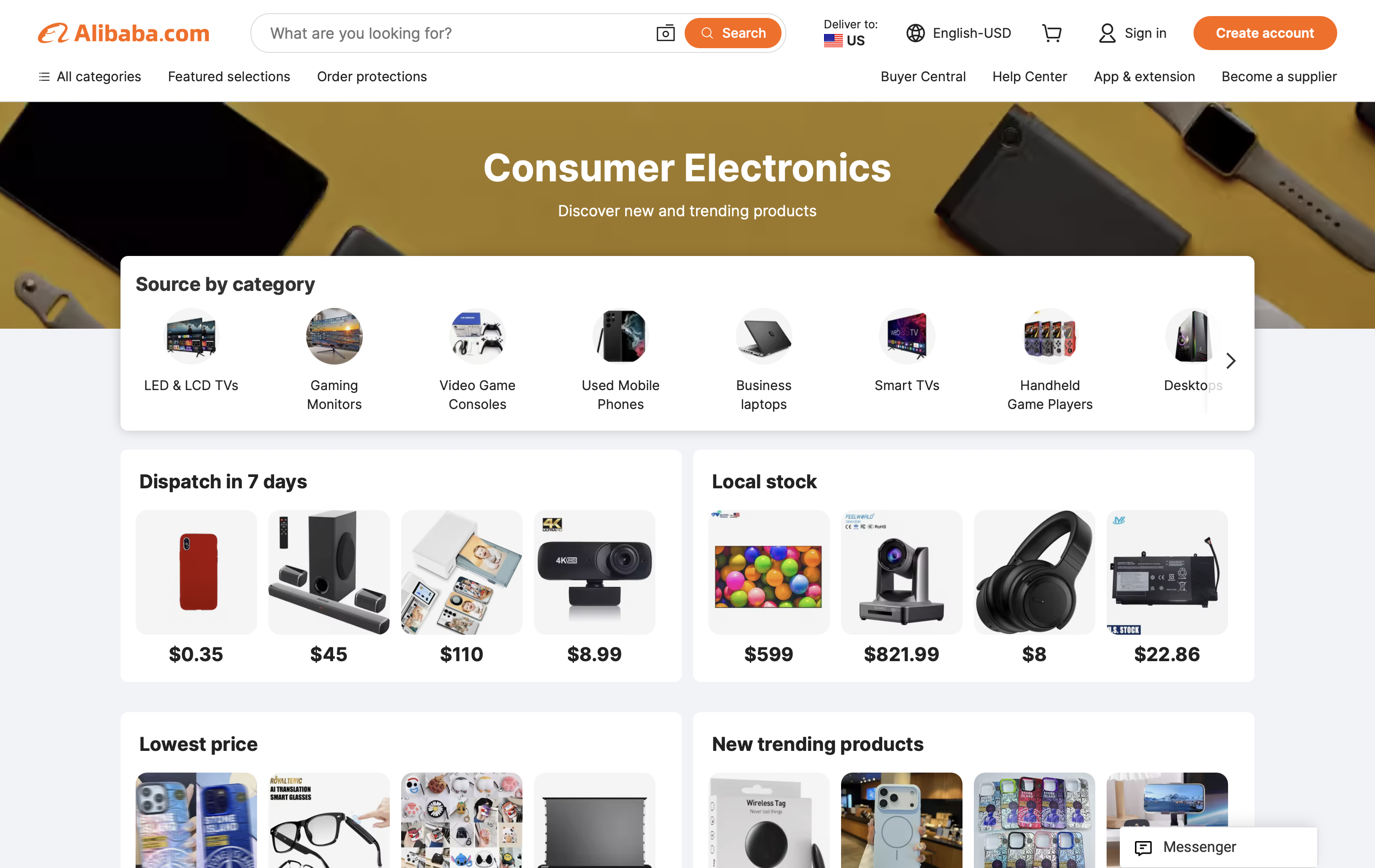
Alibaba.com is a global multi-category B2B marketplace that connects manufacturers and wholesalers, mainly from Asia, with buyers worldwide.
It works as a many-to-many, cross-border platform where companies source everything from raw materials to finished products. The model combines catalog ordering with RFQ-style requests, trade assurance, and logistics support, which makes it a reference point for export-oriented marketplace projects.
2. Amazon Business
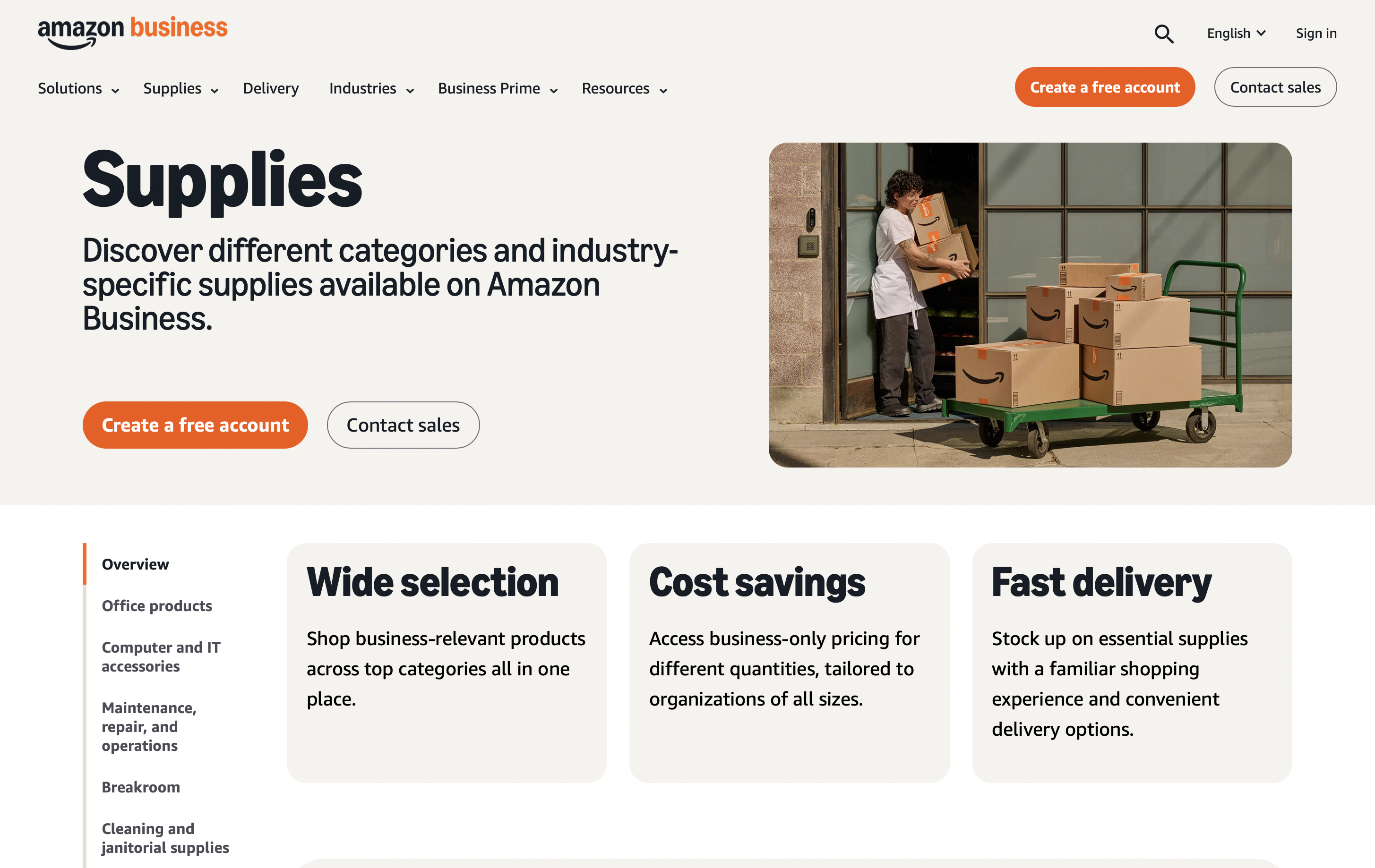
Amazon Business is a procurement-focused B2B marketplace built on top of Amazon’s infrastructure. It targets companies that want to standardize purchasing across departments.
Features like business pricing, quantity discounts, account hierarchies, approvals, and integration with procurement systems position it as a horizontal B2B marketplace for indirect spend and everyday business supplies.
3. eBay

eBay started as a consumer and auction platform, but a large part of its activity now involves companies buying and selling goods to each other.
It functions as a mixed C2C/B2C/B2B environment where professional sellers use it to move surplus stock, refurbished equipment, parts, and niche items. In B2B contexts, eBay acts as a many-to-many marketplace with strong secondary-market and long-tail assortment characteristics.
4. Faire

Faire is a wholesale business that connects small businesses with a broader market. It focuses on wholesale terms, net payment options, and curated assortments rather than consumer sales.
It is a vertical marketplace tailored to retail procurement: brands list products in wholesale packs, retailers place bulk orders, and the platform handles risk, payments, and parts of the logistics process.
Each of these platforms handles complex pricing, payments, compliance, and logistics differently, but they share one pattern: they give buyers access to many suppliers in one structured system.
B2B marketplace challenges and requirements
Running a B2B marketplace is about fitting into how companies actually buy and sell.
Once you start talking with procurement, finance, and operations teams, a few recurring constraints appear. Those constraints shape the requirements for your B2B marketplace platform far more than the UI layer.
Complex buying groups and internal approvals
In a b2b marketplace, a single order often involves requesters, managers, finance, and procurement.
Each group has its own expectations: some care about budgets, others about compliance or technical specs. Orders may need several approval steps, and the rules vary by department, legal entity, or spend level.
That means the platform must handle multi-step workflows, customer relationship management, saved carts that stay valid over longer cycles, and clear visibility into who needs to act next.
If buyers cannot replicate their internal process on your platform, they fall back to email, spreadsheets, or legacy procurement tools, and the marketplace becomes a side sales channel instead of a primary one.
Contracts, pricing, and customer-specific terms
Most B2B marketplaces deal with negotiated terms rather than public pricing.
Large buyers expect contract prices, rebates, volume breaks, and catalog restrictions that apply only to them or to certain branches of their organization. Sellers may also want different pricing tiers for different segments.
A practical marketplace for B2B needs a pricing and catalog engine that respects those rules: customer-specific price lists, contract activation and expiry, product visibility based on agreements, multiple payment systems, and consistent handling of taxes and fees.
Integration with ERP and procurement systems
Enterprise buyers rarely treat a B2B marketplace online as a standalone website. They already use ERPs and e-procurement tools to manage purchase orders, budgets, and invoices. For them, marketplace transactions have to flow into those systems, with correct identifiers, cost centers, and tax data.
From the marketplace side, that requires APIs, punchout catalog support, and stable integration patterns for orders, invoices, shipment updates, and payment status. Error handling and idempotency matter as well, since failed or duplicated messages can create real accounting issues.
Without reliable integration, procurement teams view the marketplace as “extra work” rather than a way to streamline indirect spend.
Multi-vendor logistics and operational complexity
A B2B marketplace that hosts multiple sellers has to orchestrate logistics across them. One order may contain items from different warehouses, with different lead times, carriers, and Incoterms. Buyers still want a single order reference and a clear overview of what arrives when.
That leads to several requirements: per-seller shipping methods, payment processing solutions, freight support, tracking aggregation, split shipments when needed, and sometimes consolidated deliveries for selected regions. Service-level agreements for shipping speed, damage rates, and fill rates turn into platform-level rules and monitoring.
Without clear handling of logistics, even strong assortment and pricing lose to existing distributor relationships.
Compliance, risk, and governance
Companies bring their own policies and regulatory constraints into a B2B marketplace platform. Procurement teams want control over “who can buy what” and under which conditions. Legal teams focus on data protection, export controls, and contract terms. Finance cares about audit trails and tax correctness.
The marketplace must encode policy rules (allowed suppliers, restricted product categories, approval thresholds), support tax and invoice requirements for multiple jurisdictions, and keep detailed logs of actions on the platform.
Many industries also require supplier qualification and ongoing performance checks. Without this governance layer, enterprises treat the marketplace as risky and limit its usage to low-impact purchases.
Payments, credit, and cash-flow expectations
Unlike consumer transactions, B2B orders often rely on net terms, purchase orders, and credit. Buyers expect flexibility: pay now with a card for small orders, use an invoice and net 30 for larger ones, or split payments based on milestones. Sellers want predictable cash flow and risk management.
A marketplace for B2B, therefore needs to support multiple payment methods, configurable terms, and in many cases embedded financing or credit assessment through partners.
Escrow models, dispute handling, and charge allocation between the marketplace operator and sellers are not optional details. They define how comfortable both sides feel when shifting larger volumes onto the platform.
Data quality and analytics expectations
Catalog data in B2B is often fragmented: different units of measure, missing attributes, and inconsistent naming.
At the same time, both buyers and sellers expect reliable analytics. Buyers want to spend analysis by category, supplier, and cost center. Sellers want visibility into performance, conversion, and demand patterns. Operators want GMV, margins, and operational KPIs such as on-time delivery or dispute rates.
That combination forces the marketplace to invest in data models, normalization processes, and analytics infrastructure. Clean product data feeds search quality, recommendations, and reporting.
Analytics then feed back into product decisions: which categories to grow, which suppliers to recruit, and which workflows to improve.
Taken together, these challenges define the core requirements for a serious B2B e-commerce marketplace.
The seven feature areas described in the rest of the article respond directly to those constraints and give you a practical blueprint for planning the next steps for your marketplace.
1. Vendor onboarding
Vendor onboarding refers to the end-to-end process of recruiting and integrating third-party sellers into a B2B marketplace.
A robust onboarding feature typically includes a self-service portal for vendor registration, tools to upload catalogs, and verification workflows for compliance (e.g., business credential checks, tax IDs).
It ensures new suppliers can quickly list products and start transacting, while meeting the marketplace’s quality and policy requirements.
Why vendor onboarding matters
A fast, seamless onboarding process is strategically vital because the value of a marketplace grows with its variety of sellers and products.
Streamlined onboarding lowers barriers to entry for vendors, enabling the marketplace to scale supply rapidly. According to Gartner, enterprise marketplaces that operate for over a year usually see at least a 10% increase in digital revenue – largely by expanding product assortment through third-party sellers. Conversely, a cumbersome onboarding experience can deter quality suppliers, slowing growth.
A well-designed program also performs necessary due diligence (verification, compliance checks) without excessive friction, balancing speed with trust.
In short, effective vendor onboarding helps build a broad, compliant seller base, which is the engine for assortment breadth and network effects in B2B marketplaces.
Best practices for vendor onboarding
Enable self-service registration
Provide a guided online portal that enables companies to sign up, input company info, and upload product data at their own pace.
Self-service onboarding empowers vendors to join quickly and independently, shortening onboarding time and reducing manual admin work.
Automate verification and compliance
Integrate checks for business legitimacy, tax certificates, or industry-specific licenses as part of onboarding.
For example, automatically verify documents (IDs, certifications) and conduct due diligence (credit checks, AML) to approve sellers swiftly while managing risk.
Dedicated support & training
Assign onboarding specialists or provide knowledge bases/webinars to help new sellers optimize their listings and understand marketplace policies.
Proactive support during early stages improves seller activation and long-term engagement.
Plan assortment strategically
Identify target product categories and brands and proactively recruit those sellers.
Gartner emphasizes having a detailed plan for product assortment and a dedicated team to recruit qualified sellers as part of a robust seller program.
Aligning onboarding efforts with strategic assortment gaps ensures the marketplace attracts the right mix of vendors.
2. Procurement workflows
Procurement workflows describe how a B2B marketplace aligns with the internal purchasing processes of enterprise buyers.
It includes capabilities like multi-level approval workflows for orders, budget controls, purchase requisitions, and integration with e-procurement or ERP systems.
Essentially, procurement workflow features let business customers enforce their internal buying rules on the marketplace – for example, requiring managerial approval for large purchases or routing orders to a finance team for review.
These workflows mirror the checks and sign-offs that B2B buyers use to govern spending.
Why procurement workflows matter
In B2B commerce, purchasing decisions are rarely made by a single person. In fact, the typical B2B buying group involves 6–10 decision-makers on average.
Without workflow tools, a B2B marketplace cannot support the collaborative and hierarchical nature of corporate buying.
Approval workflows and spend controls are strategically important because they ensure compliance with corporate policies (no “rogue” orders) and give companies confidence to channel significant spend through the marketplace. They also reduce errors and unauthorized spend – studies show automated approval processes can cut unapproved purchases by up to 35%.
Moreover, complex orders often need time for internal review. Features like saved carts and quote approval workflows accommodate these delays so that opportunities aren’t lost.
Overall, aligning with procurement processes is key to enterprise adoption of a marketplace, as it lets organizations buy efficiently while maintaining oversight and governance.
Best practices for procurement workflows
Support multi-level approvals
Provide configurable approval hierarchies (manager → director → VP) based on order value or category. This ensures that big or sensitive purchases automatically trigger the required sign-offs.
Multi-tier approval workflows reduce risk and ensure governance on high-value orders, leading to fewer mistakes and compliance issues.
Role-based access and spend limits
Implement role-based user permissions (e.g., buyer, approver, finance) and allow companies to set spending limits or budget caps per user or department.
For example, a department buyer might have a monthly cap, beyond which an order is escalated for approval. This mirrors internal budget controls and prevents maverick spending.
Integration with procurement systems
Offer punchout catalog functionality or APIs to integrate with buyers’ existing procurement software (e.g., Coupa, Ariba, SAP).
Through punchout, users can initiate a marketplace order from their company’s system, get it approved internally, then return the approved requisition to the marketplace for fulfillment.
Such integration into the source-to-pay cycle is powerful – marketplaces that plug into ERP/procurement systems automate and simplify sourcing, ensuring POs are correctly issued and tracked.
Collaboration tools for buying teams
Provide features like shared carts or the ability to add comments/attachments to orders and RFQs.
This allows multiple stakeholders to contribute to a purchase. Notably, shared carts can help coordinate those 6–10 decision-makers on the buying team, keeping everyone aligned on a single order.
Transparency into approval status for all participants is also critical so that employees know where a request stands in the chain.
3. Payment terms and financing
In a B2B marketplace, payment is not one-size-fits-all – buyers often expect flexible payment options beyond immediate credit card transactions.
Key features here include support for net payment terms (e.g., net 30, net 60 invoicing), purchase orders, credit lines or financing options, and multi-stage payments (like deposits or milestone-based payments).
The marketplace may also handle escrow services to hold funds until conditions are met, and must accommodate multiple payment methods (ACH transfers, wire, checks, corporate cards) and possibly multiple currencies.
Payment terms features ensure that the platform can mirror offline B2B billing practices – offering the buy now, pay later experiences and extended terms that business customers are used to.
Why payment terms and financing matter
Flexible payment terms and financing options are strategically important because B2B complex transactions tend to be larger and more complex, and invoicing with deferred payment is the norm in many industries. If a marketplace forces immediate payment on an order, enterprise buyers may not adopt it for high-value or frequent procurement needs.
Offering net terms (or integrated trade financing) improves the buyer experience and trust – for example, a buyer can place a large order and pay after 30 days, as they would with a trusted supplier.
Additionally, enabling such payments within the marketplace (through embedded fintech solutions) drives efficiency. Embedded payment solutions allow buyers to pay via invoice, ACH, or even B2B “BNPL” directly on the platform, rather than resorting to offline invoicing. This not only speeds up transactions but also reduces errors from manual processing.
A PwC analysis notes that B2B digital payment innovations (like real-time payments) are poised to replace trillions in traditional check/ACH transactions in the coming years, underscoring the industry shift to faster, data-rich payments.
Moreover, trust mechanisms like escrow are crucial in a multi-vendor environment – they protect buyers and sellers, ensuring funds are only released when goods are delivered as promised. Studies have found that escrow significantly reduces perceived risk and increases transaction completion rates on digital platforms.
In summary, robust payment term features drive adoption by aligning with how businesses manage cash flow, while maintaining trust between unfamiliar trading partners.
Best practices for payment terms and financing
Offer net terms and credit options
Allow pre-approved buyers to purchase on credit (e.g., net 30/60 days) and manage invoicing through the platform. This can be done via an internal credit program or through fintech partners that underwrite and finance receivables.
Providing a “buy now, pay later” option for B2B (such as invoice factoring or installment payments) makes the marketplace more accessible for large orders while ensuring sellers still get paid on time.
Implement escrow and payment protection
Use an escrow service for order payments – the buyer’s funds are held by the marketplace (or a third-party service) and only released to the seller upon confirmed delivery or buyer approval.
Escrow builds trust, especially when buyers and sellers have no prior relationship. For instance, leading B2B marketplaces like Faire use escrow to give new buyers confidence that they won’t be charged until they receive and verify goods.
Coupled with this, the platform should support partial payments or milestones (useful for services or large projects).
Multi-method & integrated payments
Enable a variety of payment methods – ACH bank transfers, wires, corporate credit cards, and digital wallets – all through a unified checkout.
The payment process should be embedded in the marketplace UI (no redirecting buyers to offline invoicing) for a seamless experience. For example, some marketplace platforms integrate providers like Adyen or Stripe Connect for split payments and real-time tracking, so that even if a buyer pays by invoice or on credit, the system can still distribute funds instantly to sellers.
This orchestration (splitting a single buyer payment to multiple sellers, handling taxes, and platform fees) is essential in a multi-vendor marketplace.
Transparent terms & dynamic pricing for payments
Clearly display payment terms on product pages and at checkout (e.g., “Net 45 available” or “5% discount for early payment”). If offering early-pay discounts or late fees, automate their calculation.
Also, incorporate currency conversion and tax/VAT handling if the marketplace is cross-border, with real-time exchange rates and tax calculations so that there are no surprises in billing.
4. Account hierarchies and role management
This feature allows business customers to mirror their organizational structure within the marketplace.
A parent-child account hierarchy means a company can have a “parent” account (e.g., a corporate HQ) linked with multiple “sub-accounts” (e.g., regional offices, departments, or individual buyers). Each level can have designated users, roles, and permissions.
Account hierarchy functionality often includes consolidated oversight tools – for instance, a parent account admin can see all orders placed by child accounts, set spending limits, or share corporate pricing and contracts across all sub-units. It also encompasses user management features like the ability to invite or bulk-import users and assign them roles (buyer, approver, admin, etc.).
Essentially, account hierarchy features reflect the reality that B2B relationships are many-to-many, not just single user to single supplier.
Why account hierarchies and role management matter
Supporting complex account structures is critical for enterprise adoption of a marketplace. Most large buyers operate in multiple locations or have several buying teams, and they need a unified way to manage their activity.
A parent-child hierarchy provides that “single source of truth” for the customer’s organization – enabling centralized control over decentralized purchasing. According to McKinsey, 75% of B2B companies with complex organizational structures cite hierarchical account management as crucial for scaling digital commerce efficiently.
Without hierarchies, companies might resort to creating multiple siloed accounts on the platform, leading to fragmented oversight and difficulty enforcing standard terms or aggregating spend for volume discounts.
Moreover, hierarchy management ties directly into workflow and pricing features (e.g., special pricing can apply to the parent account and flow down to all subsidiaries; approvals can roll up through the hierarchy). Strategically, this feature deepens engagement by allowing both the macro (corporate-wide) and micro (individual buyer) views of activity.
It also improves transparency between suppliers and large customers – the sales team can understand the entire relationship if they have an “account 360” view of the parent and all sub-accounts in one place.
Best practices for account hierarchies and role management
Reflect real organizational structures
Allow customers to map their internal hierarchy accurately – Company → Divisions → Departments → Individuals. Support multiple tiers of depth. Use clear labeling (parent account, child account) and allow grouping of users under each node.
This mapping should enable inheritance of settings (a parent company can set global parameters like payment terms or contract pricing that all children inherit).
Granular roles and permissions
Provide role-based access control at each hierarchy level. For example, a parent account admin can oversee all sub-account orders and maybe approve large purchases, while a child account user might only see their own department’s data.
Enabling role-based permissions (buyer, approver, admin, etc.) and easy user administration (including bulk user uploads) helps large enterprises onboard entire teams and manage them efficiently. Also allow the hierarchy to evolve – e.g., transferring a sub-account to a different parent or merging accounts – as company structures change.
Consolidated reporting and shared resources
Include dashboards or reports that roll up data from all sub-accounts to the parent level (total spend, orders by division, etc.), as well as the ability to drill down into individual units. This gives the enterprise a 360° view of their activity.
Likewise, let companies share assets across the hierarchy: for instance, a centrally negotiated contract or catalog can be applied marketplace-wide for that customer. Pricing agreements or volume discounts set at the parent level should automatically apply to all relevant sub-buyers.
Self-service management for customers
Provide tools for the corporate client’s administrators to manage their hierarchy on their own. This could include inviting new users, defining approval rules per department, or updating profile information for each branch.
Self-service management empowers the account owner to keep their structure up-to-date and reduces the dependency on the marketplace’s support team for routine changes. For example, allowing a customer’s admin to bulk-import a list of 100 buyers at once, or to promote a buyer to an approver role via the UI, saves time and encourages more active use of the platform.
5. Fulfillment and logistics integration
Fulfillment features in a B2B marketplace cover how orders are delivered from sellers to buyers, with an emphasis on speed, reliability, and transparency.
This domain includes order orchestration (especially when multiple vendors are involved in one order), shipping options (e.g., freight, parcel, LTL trucking for large goods), tracking and status updates, and potentially the ability for buyers to select delivery windows or schedule shipments.
It also involves inventory management – knowing stock levels and lead times – and handling of partial shipments or backorders. In essence, the marketplace must coordinate the end-to-end logistics so that once an order is placed, the right vendor(s) fulfill it in a timely manner, and the buyer can monitor the process.
In multi-seller scenarios, fulfillment features may consolidate shipments or at least consolidate tracking information for the buyer.
Why fulfillment and logistics integration matter
In B2B commerce, failure to deliver on time or in full can break relationships – businesses often depend on deliveries to keep their operations running. As B2C e-commerce has raised expectations, B2B buyers now also demand lightning-fast delivery, real-time tracking, and proactive notifications about their orders.
A marketplace must excel at fulfillment to provide a competitive customer experience, otherwise, buyers will revert to traditional distributors who have proven logistics.
Strategically, robust fulfillment capabilities are a key differentiator. They allow the marketplace to offer faster and potentially cheaper shipping by leveraging scale. For example, McKinsey notes that large online marketplaces often achieve faster throughput times and better shipping rates than individual contracts can, thanks to advanced logistics and bulk volume.
Additionally, good fulfillment integration reduces the complexity for buyers of dealing with many suppliers. Instead of a buyer tracking multiple packages on different vendor websites or receiving dozens of separate deliveries (one per vendor), the marketplace can unify the experience.
Some leading operators even arrange for one consolidated delivery for multi-supplier orders to cut down costs and improve convenience.
Ultimately, fulfillment affects customer satisfaction directly. Late or fragmented deliveries erode trust, while smooth fulfillment builds confidence in the marketplace model for critical business purchases.
Best practices for fulfillment and logistics integration
Offer flexible and consolidated shipping options
Enable buyers to choose shipping methods appropriate for B2B orders – e.g., freight for large pallets, express parcel for urgent small orders, or scheduled deliveries for just-in-time needs. Where possible, consolidate shipments from multiple vendors if a buyer places a single order with multiple items.
A unified fulfillment approach (one delivery per order) not only lowers costs by reducing duplicate shipments but also improves the buyer’s experience by simplifying their receiving process. Clearly communicate any split shipments when they are necessary, and strive to minimize them.
Real-time order tracking and notifications
Integrate with carriers and require sellers to provide tracking information for every shipment. The marketplace should present a single tracking dashboard to the buyer that shows the status of all packages in one place (even if different shippers are used).
Send proactive notifications for key events – e.g., item dispatched, out for delivery, delayed, delivered. This level of visibility is expected in the modern market, as noted, B2B customers want by-the-minute tracking and updates, similar to consumer deliveries. Proactive communication about delays or partial shipments is especially critical to allow buyers to adjust their plans.
Lead time transparency and inventory visibility
Display stock availability and lead times for each product before purchase. If an item will ship in 2 days vs. 2 weeks, the buyer should know upfront. Providing accurate availability and allowing buyers to select future fulfillment dates (for scheduled shipments) helps them plan around project timelines.
For build-to-order or backordered items, show expected ship dates. Sharing this information manages expectations and reduces post-order inquiries.
Align with SLA and quality requirements
Implement service-level agreements for sellers around fulfillment (e.g., ship within 48 hours, maintain a certain on-time delivery rate) and monitor compliance. The marketplace can score or penalize vendors who consistently ship late or cancel orders.
Additionally, allow buyers to rate fulfillment satisfaction. Internally, use analytics on fulfillment metrics (on-time rate, average delivery time, split shipment frequency) to continuously improve logistics partnerships or offer programs like “certified fulfillment” for top-performing sellers.
In industries where installation or special handling is needed, consider offering value-added logistics services (either directly or via partners) to complete the fulfillment cycle (e.g., white-glove delivery, assembly on site).
6. Compliance and governance
In a B2B marketplace context, compliance refers to both internal purchasing compliance and external regulatory compliance.
Internal compliance covers adherence to company policies, budgets, approval rules, and supplier restrictions. External compliance involves meeting legal, industry, and contractual obligations, such as tax rules, export controls, safety requirements, and data protection laws.
Compliance features on a marketplace include enforcing purchase approvals, restricting product visibility based on user roles, validating tax details, managing tax exemptions, and keeping complete audit trails of transactions.
Another part of compliance is supplier qualification: collecting certifications, tracking performance, and monitoring whether vendors meet required standards.
All of this ensures that marketplace usage does not result in breaches, such as buying from unapproved suppliers, exceeding spend limits, or violating regulatory constraints. Reporting tools allow administrators to audit activity at the buyer, department, or organization level.
Why compliance and governance matter
Large enterprises will only embrace a marketplace if it aligns with their compliance requirements. Procurement teams aim to reduce “rogue spend”, purchases made outside approved channels or contracts. A marketplace that consolidates long-tail spend into a controlled environment gives companies visibility and reduces the risk of off-contract buying.
McKinsey notes that around 20% of indirect spend is distributed across 80% of vendors, which makes oversight difficult. A marketplace helps centralize this activity and reveal purchases that previously happened through informal channels.
External compliance is equally significant. If the marketplace sells regulated goods, such as chemicals, industrial equipment, or medical supplies, it must verify buyer eligibility and enforce appropriate rules.
Missing these checks can lead to legal issues and loss of trust. Blocking specific transactions, enforcing user restrictions, and validating documentation help maintain a safe trading environment.
A strong compliance framework also supports audits, legal reviews, and sustainability reporting. Features such as tax handling, proper e-invoicing, and export/import checks reduce manual work and ensure the marketplace operates within regulatory boundaries.
Best practices for compliance and governance
Enforce policy through system rules
Use the platform’s rules engine to encode procurement policies. This may include blocking orders for restricted categories, requiring additional approval for high-value purchases, or allowing buyers to interact only with approved suppliers.
Maintain catalogs of approved and blocked vendors per organization, so buyers see only what they are allowed to purchase.
Tax and regulatory compliance automation
Integrate tax calculation engines and exemption management tools. Allow buyers to upload exemption certificates and automatically apply them at checkout.
Generate accurate e-invoices for each jurisdiction, and apply export/import checks for international transactions.
Follow privacy laws such as GDPR and CCPA by providing consent flows and data removal options.
Supplier qualification and monitoring
During onboarding and ongoing operations, collect supplier certifications, safety documents, or insurance details. Keep these records updated, possibly through integrations with third-party risk data services.
Monitor seller KPIs such as delivery speed, return rates, and customer complaints. Use a compliance dashboard to identify underperforming or non-compliant suppliers and take corrective actions.
Audit trails and reporting
Log every relevant action – orders, approvals, changes in user roles, pricing updates – and make these logs available for audits. Offer downloadable reports showing who bought what, when, and under which approvals.
Internally, use anomaly detection to identify unusual behavior, such as repeated overrides or suspicious ordering patterns. Reliable audit trails help companies maintain transparency and control compared to offline purchasing.
7. Analytics and insights
This feature domain involves providing data analysis and reporting tools to all stakeholders – marketplace operators, sellers, and buyers.
For operators, analytics dashboards might track overall GMV, category performance, buyer and seller growth, and operational KPIs such as fulfillment speed or dispute frequency.
For sellers, analytics typically include sales reports, traffic, and conversion metrics on product listings, and performance benchmarks relative to peers.
For buyers, especially enterprise accounts, analytics often focus on spend analysis, category allocation, savings versus contract pricing, and usage metrics for internal teams.
In short, analytics turn marketplace activity into structured insights. Capabilities may include customizable reports, real-time dashboards, and predictive models such as demand forecasting or product recommendations.
Given the volume and complexity of B2B transactions, analytics help uncover trends across categories, regions, and suppliers – showing what sells, where bottlenecks form, and which partners consistently outperform others.
Why analytics and insights matter
A B2B marketplace generates large amounts of operational, transactional, and behavioral data. When structured properly, this data supports continuous improvement across the entire ecosystem.
Operators can analyze conversion patterns, identify low-performing categories, or manage inventory gaps before they become issues.
Sellers benefit from understanding customer behavior and optimizing assortments, pricing, and availability. Aggregated marketplace data helps them see trends they wouldn’t detect on their own.
Buyers gain visibility into procurement behavior across their organization, helping them track spend, compare departments, and plan budgets.
McKinsey reports that B2B companies using analytics in sales and marketing are 1.5× more likely to outperform peers. Faster decision cycles are another effect: unified dashboards reduce the time managers spend gathering data and increase the time spent evaluating options.
Overall, analytics move the marketplace from a simple transaction engine to a source of structured insights that guide purchasing, selling, and operational planning.
Best practices for analytics and insights
Real-time dashboards with key KPIs
Provide interactive dashboards tailored to each user type. A seller may need daily sales, inventory gaps, and product-level conversion data. A buyer may require monthly spend by category, supplier breakdowns, or budget tracking.
Data should update in real time or near real time. Industry-specific metrics, such as fulfillment lead time or quote-to-order conversion, can add further context.
Customizable and exportable reports
Allow users to select metrics, filters, date ranges, and product or region scopes. Enterprise buyers and larger sellers often request scheduled report delivery or CSV/XLS export for offline analysis.
API access for integration with BI systems supports more advanced workflows. Benchmark data, such as a seller’s delivery times compared to marketplace averages, can encourage improvements without revealing competitor identities.
Advanced analytics and alerts
Move beyond descriptive metrics by offering forecasting, recommendation models, and anomaly detection. Forecasts might highlight when stock needs replenishment.
Buyer-side alerts can flag spend that is trending above budget. Seller-side alerts can notify teams if fill rate, cancellation rate, or on-time delivery drops below a threshold. These tools help users act before issues escalate.
Use analytics for personalization and marketplace growth
Apply collected data to adapt the marketplace experience. Buyers can receive product recommendations based on past orders, while sellers can be notified about categories with rising demand.
Analyze funnel behavior to find friction points, such as frequent drop-offs during the RFQ process, and use these findings to refine UX and workflows.
Share aggregated insights with stakeholders through periodic reports, such as procurement trend overviews for buyers or top-performing categories for sellers. These insights support planning and position the marketplace as a strategic partner rather than a transactional tool.
Each of these features plays a pivotal role in the enterprise-level complexity of B2B marketplaces. A well-designed B2B marketplace platform tightly weaves these capabilities to facilitate smooth buyer-supplier coordination, ensuring that large organizations can transact with confidence and efficiency.
By following best practices and learning from industry leaders (McKinsey, Gartner, Deloitte, etc.), marketplace operators can build a solution that not only enables transactions but truly transforms how businesses interact and collaborate in the digital age.
How to build a B2B marketplace in 3 steps
Creating a B2B marketplace is a staged process that starts with understanding your operational reality and ends with choosing a platform that can support complex B2B workflows, multi-vendor orchestration, and long-term scalability.
Below is a practical three-step approach adapted for companies planning to build or rebuild their B2B marketplace in 2026.
1. Discovery and gap analysis
If you already have an eCommerce system, start by auditing your current setup. Identify where it fails to meet B2B marketplace expectations. Look closely at vendor onboarding, catalog management, approval workflows, multi-vendor logistics, ERP integrations, contract pricing, payment terms, compliance rules, and analytics.
Document all the manual processes, workarounds, missing capabilities, and areas where you lack control. This gives you a clear “before and after” picture and helps define the technical and operational requirements for your future marketplace for B2B.
If you’re starting without an existing store, begin by mapping your business model and operational workflow from the ground up. Clarify:
- which vendors you plan to onboard and how their catalogs will be structured,
- which B2B features your buyers need (roles, approvals, budgets, payment terms, logistics expectations),
- which integrations and third-party tools your marketplace must support (ERP, procurement tools, tax engines, payments, shipping),
- how fulfillment will work across multiple sellers,
- what level of customization you need for pricing, quoting, and compliance.
Instead of identifying gaps, you are defining the baseline requirements and constraints for your marketplace architecture. This step prevents you from choosing technology that looks good on paper but cannot support B2B workflows later.
In both cases, the goal is the same: create a precise specification for what your marketplace must deliver, not only for launch but also for long-term significant growth.
2. Research platforms and architectural approaches
With your requirements defined, evaluate the technologies that can serve as the foundation for your B2B marketplace.
Compare them by architecture, customization depth, transaction fees, transparent pricing, data ownership, operational features, security expectations, and total cost of ownership.
Review how each option handles the seven core features discussed earlier: vendor onboarding, procurement workflows, payment terms, account hierarchies, logistics, compliance, and analytics.
If you need structured support, we’ve prepared a comparison of the most popular 11 multi-vendor marketplace platforms – analyzing them across pricing, deployment models, customization, and enterprise readiness.
It’s a helpful way to benchmark your options before committing to a technical path.
3. Choose the marketplace software that enables business growth
Your chosen platform should support the workflows your business depends on and give you room to grow, without forcing you into rigid logic or app-driven limitations. Look for an architecture that allows custom development, multi-vendor orchestration, and full control over backend logic.
Once the platform is selected, you can move into implementation: defining data models, configuring B2B features, secure platform, building vendor-facing tools, integrating ERP and procurement systems, and setting up workflows for pricing, payments, fulfillment, and compliance.
If you’re planning your next move, or need guidance on selecting technology, estimating TCO, and designing a marketplace architecture – let's talk!
With the right preparation and technical direction, you can build the B2B marketplace with all the essential features your operations actually require.
Start building your B2B marketplace today
If you’ve gone through the 7 feature domains in this guide, you can already see that the core decision in marketplace development is choosing an architecture that can handle complex B2B operations from day one and stay flexible for your business growth.
Whether you are extending an existing ecommerce stack or starting with a clean slate, the next step is to define a technical foundation that supports vendor onboarding, buyer-specific procurement workflows, multi-vendor fulfillment, flexible payment terms, and clear governance over data and access rights.
If you are planning a new B2B marketplace, comparing technology options, or want support in turning requirements into a concrete architecture, let's talk!
We can review your operational model, assess possible approaches, and help you design a marketplace platform that reflects real B2B processes instead of temporary workarounds.
FAQs on B2B marketplaces
What is a B2B marketplace?
A B2B marketplace is an online platform where multiple businesses sell products or services and buy them. Unlike a traditional eCommerce store, it supports multiple independent vendors, customer-specific pricing, payment terms, approval workflows, and complex logistics. Its purpose is to centralize procurement and create a structured environment for multi-vendor transactions.
What are the 4 types of B2B markets?
The four commonly referenced B2B market types are:
1. Producers – companies that purchase raw materials, components, or services to create finished products.
2. Resellers – distributors, wholesalers, or retailers buying products to resell to other businesses.
3. Governments – public-sector buyers procuring goods and services under regulated conditions.
4. Institutions – organizations such as hospitals, schools, or NGOs with their own procurement processes and requirements.
These groups differ in procurement rules, decision-making structures, and the level of compliance and documentation required.
What does B2B marketplace mean?
A B2B marketplace refers to a digital environment where multiple businesses transact with each other in a controlled and structured way. Sellers manage their own catalogs and pricing, while buyers place orders using terms, roles, and processes that reflect their internal procurement rules. An online marketplace can support many-to-many transactions, RFQs, contract pricing, multi-vendor fulfillment, and integrations with ERP or procurement systems.
Is it hard to start a B2B marketplace?
Starting a B2B marketplace is achievable, but it requires more planning and technical structure compared to a B2C digital marketplace. The complexity comes from features that businesses need in order to operate at scale: multi-level approvals, account hierarchies, vendor onboarding, flexible payment terms, logistics coordination, and compliance requirements.
You don’t need all features on day one, but you do need a platform that can support them as you grow. With a clear requirements analysis and the right technology foundation, launching a B2B marketplace is straightforward.
Sources
Supporting insights and data were drawn from authoritative industry research and examples, including Gartner’s analysis of enterprise marketplaces, McKinsey’s reports on B2B digital sales and procurement, and other expert studies that highlight the impact of these features.
These references underscore the strategic importance of each feature and the benefits of adopting best-in-class practices in B2B marketplace design and operation.
- 11 Imperatives When Building an Enterprise Marketplace | Gartner
- The State of the Enterprise B2B Buyer’s Journey – Advertising Week
- How B2B online marketplaces could transform indirect procurement | McKinsey
- B2B real-time payments | Deloitte Insights
- How on-demand delivery is revolutionising B2B e-commerce | DHL Express Singapore
- B2B commercial analytics: What outperformers do | McKinsey