
12-week migration from Shopware to Medusa for Novodom – expanding home & living company with 32,000+ products
Rigby moved Novodom, part of the Biesiada Invest holding group, from Shopware to the Medusa platform with 32,000+ products in 12 weeks. After the migration, new features are developed 50% cheaper and 2x faster, while the store handles 4x more traffic.


Client
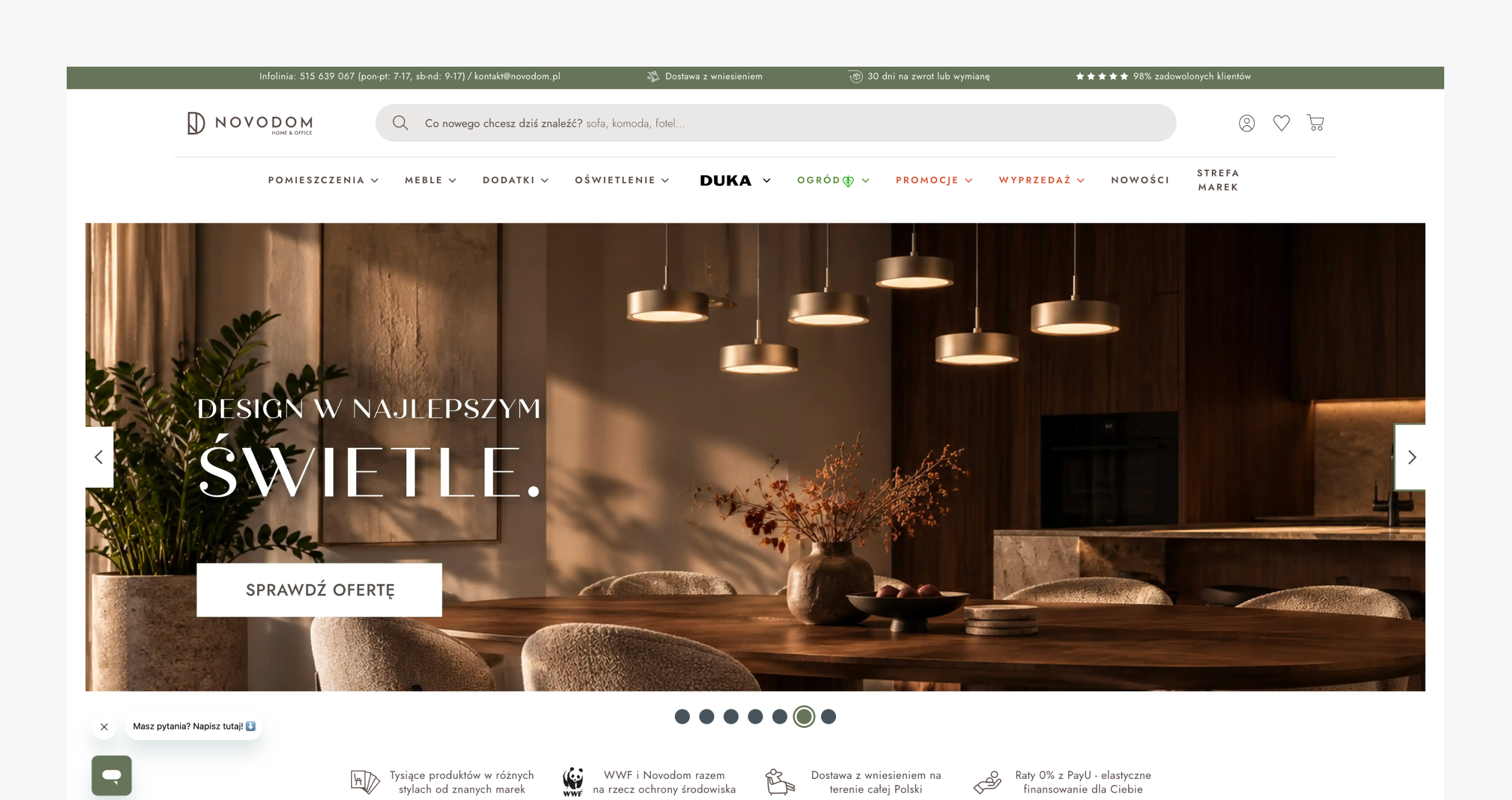
Novodom is a home & living company selling furniture, lighting, décor, textiles, appliances, and tableware. The store sells 32,000+ products across 1,400+ categories and 155 brands – all shipped from 5 warehouses and by 50+ dropship suppliers. It serves 100,000+ users a month.
Novodom is part of Biesiada Invest, a holding of 15 companies and 200+ employees. Its home & living segment brings together Novodom, Biuro Paczka, Sofi Beri, DUKA, and Signal Meble.
Biesiada Invest is in the middle of a significant expansion. Novodom is meant to open new countries and host the other brands in the group, so the platform has to support growth at that scale.
Delivered the migration ahead of a rigid deadline
Opened the platform to new countries without rebuilds
Created one shared platform for several brands
Download case study
to full migration
products migrated
faster response time
Problems

Challenge
Novodom's store ran on Shopware 6 with a paid licence. Every change on the platform was slow and expensive, and the pace did not match the ambitions of Biesiada Invest's big expansion plans.
Shopware could not keep up with the pace of the group
Biesiada Invest is expanding fast, with new brand shops, new countries, and a growing catalogue. After workshops, Novodom concluded that the store needed a faster platform and a faster way of working. Shopware wouldn't support the plans for the coming years, and replacing it before the season made more sense than adding more custom code.
On Shopware, every new shop and every new country meant a separate project. A group that opens shops and markets at the pace of its plan cannot wait weeks for each step. Novodom wanted a platform with no licence fees and code it owns, built to open new shops and markets from one catalogue, and a partner that delivers at the pace of the group.
The deadline decided the project. The new store had to go live before the season, or it would not launch this year, and the whole migration had to fit into just over three months. For a store with 32,000+ products and 31,000+ URLs, that was an extremely tight schedule.
One catalogue and warehouse for every new shop and market
The group wants to open shops for its other brands, such as Zenjoy and DUKA, and to enter the Czech Republic, Slovakia, Romania, France, and Hungary. Each of them is meant to sell from one catalogue and one warehouse.
On Shopware, every new shop and every new country needed a separate deployment. Each deployment was a new, costly project that delayed the sales it was meant to start, so expansion moved slower than the group planned.
SEO migration of 31,000+ URLs
Novodom set the rule for the project: copy the store 1:1 and improve it after launch.
The SEO migration alone covered 31,000+ URLs with about 20,000 301 redirects, next to 22,000+ historical orders, 2,800 content blocks, and 1,400 media files. A URL that returns an error after launch drops out of search results and takes its organic traffic with it.
The content came from the Shopware CMS and had to be rebuilt as fully editable blocks in a new CMS, so the marketing team could keep working from the first day.
Unusual industry requirements
Furniture retail brings requirements that standard eCommerce platforms do not cover. Each feature had to be built from scratch on the new platform and match the behaviour of the Shopware store exactly.
- Shipping dates and delivery costs depend on
- the variant and the supplier,
- the weight and size of each item,
- free-delivery rules for selected brands
- and customer groups.
- Orders can ship in several parcels from several warehouses, and the 30-day return window starts from the last parcel.
- Every sale has to show the lowest price from the previous 30 days under the Omnibus directive
- B2B programme for architects gives each approved account its own discount and a commission code.

Solutions
Thanks to Canso, our AI-native delivery framework, the store went live in 12 weeks, ahead of the client's deadline of just over three months.
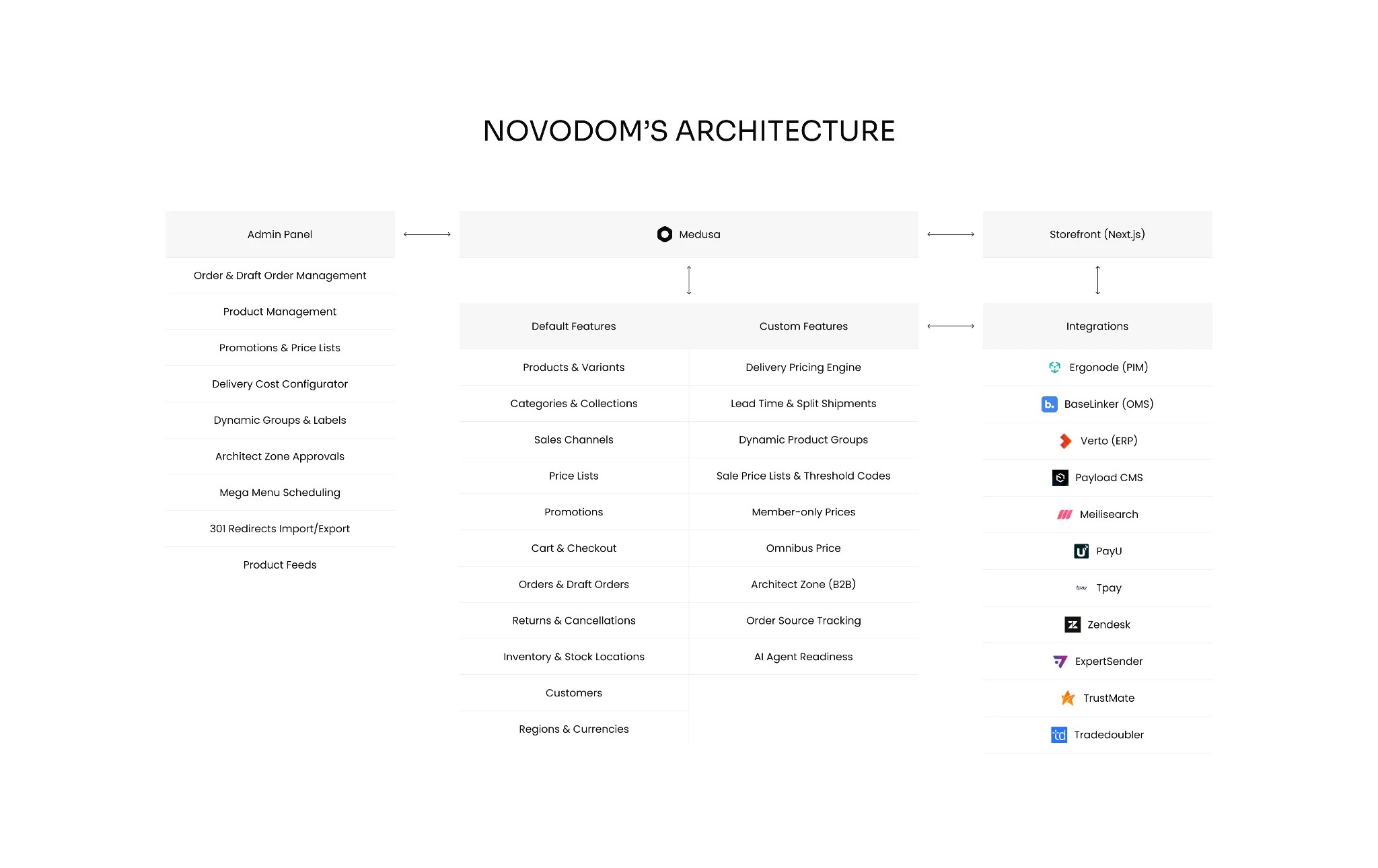
Novodom's store was migrated from Shopware to Medusa, with a Next.js storefront and Payload CMS. It is connected to the group's product, order, and ERP systems, and the catalogue, orders, redirects, and content moved across with it.
Our team led the project from the first discovery workshop to the launch, designing the architecture and building the new store with every integration behind it. Novodom worked with a lead developer who led all technical work from start to finish, the CTO who designed the architecture, a UX and UI designer who ran the workshops, and a project manager who kept the project on track.
Delivery with AI-native framework
Canso is our AI-native delivery framework that works in 4 steps. With it, our team delivered the project ahead of the deadline.
- Context before code. Before AI wrote anything, it received context of the project requirements and maps of every integration written.
- Specification before implementation. More than 100 specifications, one per area of the store, defined what to build before anything was built.
- Project memory in the repository. More than 240 decisions and the state of the work are recorded in files, so every session started where the previous one ended, and several streams of work ran in parallel.
- Verification by a second role. A separate AI role checked the first one's work against tests and evidence and issued a verdict, so errors surfaced before deployment.
Migration to Medusa as the commerce core
Novodom chose Medusa because the platform has no licence fees, the code fully belongs to the client, and it can be extended with the custom logic a furniture store needs.
Medusa took over everything the Shopware store did. It now runs: catalogue, variants, categories, collections, carts, checkout, orders, returns, cancellations, price lists, promotions, stock locations, customer accounts with wishlists, and the admin panel.
Our custom modules add everything specific to Novodom: the integrations, the delivery engine, dynamic product groups, the architect programme, product feeds, the mega menu and redirects.
On Shopware, every new brand shop and every new country would have been a separate deployment, and would be extremely expensive. On Medusa, it is another sales channel or region on the same instance.
AI agent readiness
The store is prepared so that AI assistants can read its catalogue and recommend its products.
Every product page carries full schema.org structured data: price and discounts, availability, brand, images, customer ratings and reviews, the return policy, and delivery cost and time.
The store also publishes an llms.txt guide that describes the catalogue, shipping, returns, and contact details in a format AI models read directly, and each product is available as a clean Markdown page.
For AI shopping agents, our team added a Universal Commerce Protocol endpoint. An agent can search the catalogue, check prices and stock, and put together a cart, and the customer gets a link that opens the checkout with that cart ready to pay.
ChatGPT, Gemini, and Perplexity get accurate prices, stock, and terms straight from the store and do not have to estimate them from the page layout. A recommendation from an AI assistant is one click away from an order.
Delivery pricing engine, lead time, and split shipments
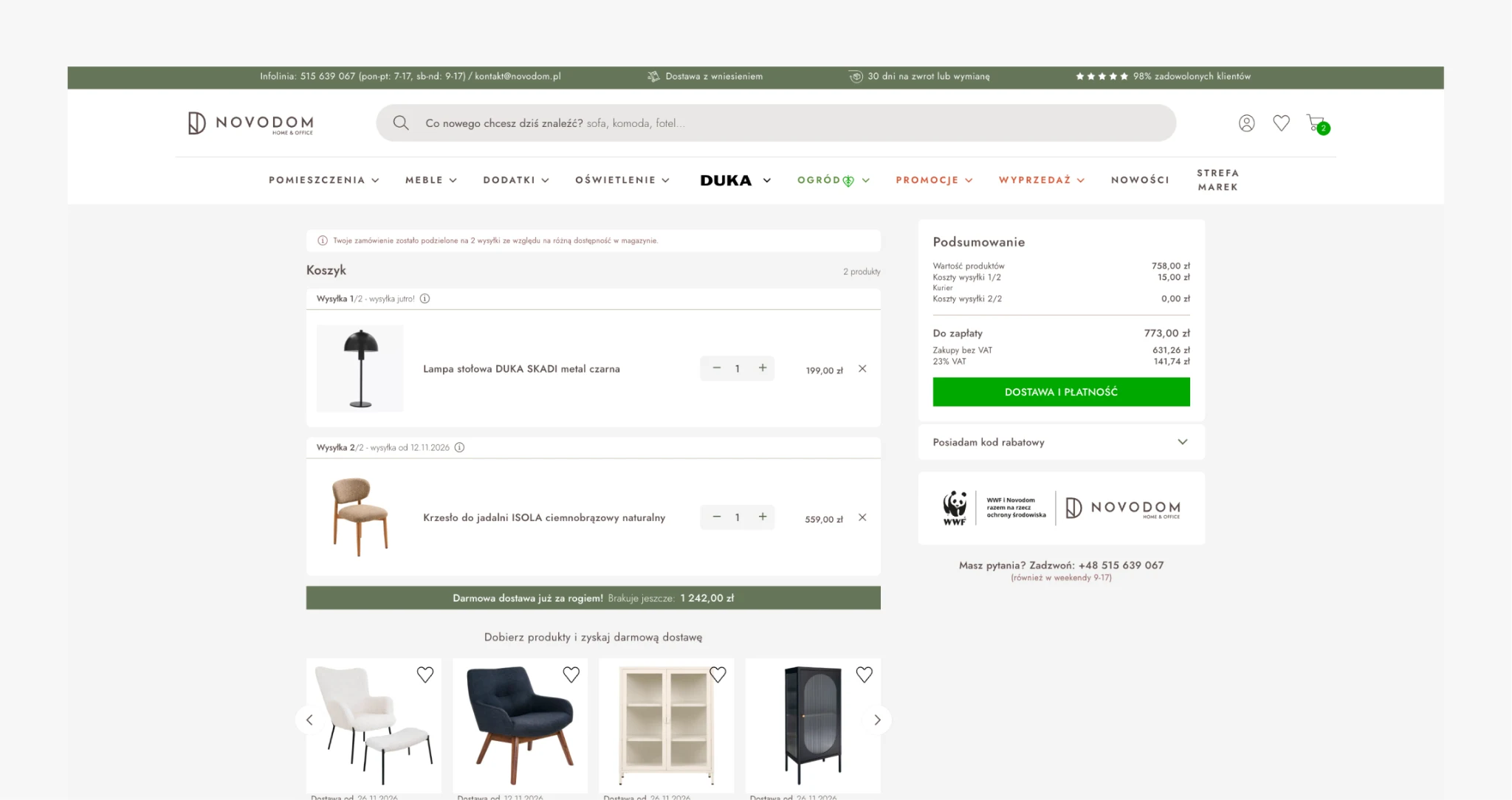
Our team rebuilt the Shopware delivery price lists, free-delivery thresholds, and priority engine 1:1, connected the external warehouse, and gave the logistics team a cost configurator in the admin panel.
For every cart, the store calculates the shipping time from the lead times of the warehouses involved and splits the order into parcels.
The logistics team changes costs and thresholds itself in the admin panel. On Shopware, the same change took about two weeks.
Dynamic product groups
A product group is a set of rules, such as a brand, a category, or an attribute, combined with AND and OR. Labels, promotions, free delivery, and product feeds all use these groups.
A rule is written once, and every product that matches it gets the label, the promotion, the delivery terms, and the feed entry, including products added later.
Without groups, each of these would be a manual list across 32,000+ products that someone has to keep updating.
Sale price lists and threshold codes
Sales run on generated price lists that recalculate on a schedule, for groups of up to 45,000 variants. Our team also built threshold codes, which give a discount once the cart reaches a set value. When promotions collide, the highest discount wins.
Marketing launches a sale across 45,000 variants without editing a single price by hand. Done manually, a sale of that size means 45,000 price changes to make and 45,000 to undo.
Member-only prices
Some prices are visible only to logged-in customers. A member price appears after login, and visitors who are not logged in see the regular price.
Novodom can reward registered customers with a better price without changing the price anyone else sees.
Omnibus price
The Omnibus directive requires every sale to show the lowest price from the previous 30 days. Our team made the store work this out for each product on sale, including sales that run on generated price lists.
Without it, the lowest price of every product in a sale of up to 45,000 variants would have to be checked by hand, and a wrong figure would break the directive.
Architect Zone for B2B customers
Architects register in the shop, and a Novodom employee approves each application. Each account gets its own discount, calculated from the promotional price, and architects receive codes that pay them a commission.
Novodom sells to architects through the same shop, with a separate price for each account. Every commission can be traced to the order and the code that earned it.
Order source tracking
The store records where each order came from, using the UTM parameters of the link the customer arrived through. Marketing can see which campaign and channel brought every order.
Draft orders for the customer service team
Customer service creates phone orders in BaseLinker, and they appear in the customer's account in the shop.
The customer sees a phone order in the account together with the rest of their history, so returns and complaints go through the same process as web orders.
Mega menu scheduling and 301 redirects
The mega menu is managed by drag and drop, and each item has its own display schedule. Our team imported about 20,000 redirects and built tools to import and export them.
A redirect sends customers and search engines from an old address to the new page, so old links and rankings keep working.
Product feeds for Google, Meta, and TradeDoubler
We built several independent, configurable feeds with filters based on the dynamic product groups. Marketing chooses which products go out, so each channel advertises the part of the catalogue that fits it.
Product data from the Ergonode PIM
Ergonode is the product information system (PIM) that holds products, attributes, and variants for the group. Our team built a bridge that reads that data into Medusa, so a catalogue of 32,000+ products with up to 150 SKUs per product is maintained in one place.
The catalogue team edits a product in one place, the PIM, and the change reaches the store automatically.
Orders, stock, and invoices through BaseLinker & Verto
BaseLinker is the order management hub that connects the store to its logistics partners, and Verto is the ERP.
Orders now flow from the shop to BaseLinker and on to Verto, and prices and stock levels come back from BaseLinker into Medusa. The bridge also carries order statuses, payments, invoices, shipment tracking, cancellations, and partial returns in both directions.
Every order, stock level, and price now has one source of truth, so the shop and the ERP show the same numbers.
Content in Payload CMS
Payload CMS replaced the Shopware CMS. Our team moved all of the content from the Shopware CMS into it: 2,800 content blocks and 1,400 media files, rebuilt as fully editable blocks, together with the landing pages, the blog, and the newsletter. Editors see a Live Preview of every page.
The marketing team edits and previews pages itself. New landing pages no longer wait two weeks for a developer to release them.
Search, payments, and customer tools
- Meilisearch replaced Doofinder as the open-source search engine.
- PayU and Tpay handle payments by BLIK, card, and bank transfer.
- Zendesk handles complaints.
- ExpertSender handles the newsletter.
- TrustMate handles customer reviews.
- TradeDoubler handles affiliate links.
- GUS and CEIDG lookup checks the tax numbers of B2B customers.
Results
Novodom trusted us to build the commerce of a group with big plans. We enabled their growth by building the foundation for it.
Rigby rebuilt Novodom's platform on Medusa, migrated 32,000+ products, 22,000+ orders of history, and 31,000+ indexed URLs, and launched the new store in 12 weeks, ahead of a rigid deadline of just over three months.
The platform now opens new shops, brands, and countries from one catalogue, so the store can grow with the group.
Full platform ownership with no licence fee
On Shopware, Novodom paid a licence fee for a commercial plan, and the platform stayed under the vendor's licence. Medusa carries no licence fee, and the whole code belongs to Novodom.
Platform ready for expansion to new countries
On Shopware, every new country needed a separate deployment, which meant a new platform to build and pay for. On Medusa, a new country is a region on the existing platform, so it opens faster, is easier to run, and costs less.
New features and changes are 50% cheaper and 2x faster to deploy
New features and changes to the platform come out 50% cheaper and 2x faster than the same work on Shopware.
The reason is the architecture. Medusa is built from separate modules, so a new feature is a new module that leaves the core untouched, and the Next.js storefront changes independently of the backend.
On Shopware, anything beyond the standard went into the core, or a custom plugin that had to stay compatible with every platform update.
10x faster response time
After the migration, the store's response time at 50 simultaneous visitors fell from over 10 seconds to under 1 second. The gain comes from a second backend copy and the optimisation after launch.
4x more traffic handled by the store
One week after migration, the new platform let Novodom handle 4x the traffic it handled before. The company now has room for more visitors during the high season and for new campaigns.
Faster website loading
After the migration, the product page loads 57% faster, the home page 46% faster, and listing pages 20% faster. The gain comes from the new Next.js storefront and the optimisation after launch.


Biesiada Invest is growing fast, and our platform had to keep up. Rigby moved Novodom from Shopware to Medusa in 12 weeks, ahead of a deadline many would have called unrealistic, without disrupting sales or our marketing team's work. The migration was remarkably smooth, and the new setup gives us what we were missing: speed in rolling out changes, full ownership of our code, and a foundation for new brands and markets. Rigby worked like part of our own team: fast, transparent, and genuinely invested in the result.
Let’s build together
Let’s talk about how we can build your commerce project — tailored to your business, powered by Rigby


















Got a commerce
modernization challenge?
Let's talk
A 30-minute Commerce Future Session - tailored to your stack, your challenges, your roadmap. No pitch. Just perspective. No preparation needed on your side.

“Whether you're exploring migration, struggling with legacy complexity, or just want a second opinion - we're here.”