Let’s talk about how we can build your commerce project — tailored to your business, powered by Rigby
The old eCommerce delivery model is breaking.
- Platforms take years to modernize.
- Budgets explode.
- Maintenance becomes reactive firefighting.
Every leadership team running a legacy commerce platform eventually asks the same question: if AI exists, why is building and running commerce still so slow and expensive?
The answer is uncomfortable. Most agencies still sell time, and "AI-native" tools sell experiments. But commerce platforms aren't experiments. They run revenue, operations, and companies.
After 30+ delivered commerce platforms, 600+ custom commerce features delivered, and maintaining $6B+ client trade volume, we decided to be one of the first agencies to rebuild this experience into a new model.
We believe the next generation of eCommerce and marketplace platforms will be migrated, built, and maintained differently, so we’ve poured our whole commerce experience into our own process of delivering software… We’ve named it Canso.
It's an AI-native framework for commerce modernization that compresses migration, build, and maintenance into a system designed around outcomes instead of billable hours.
If you're running a legacy commerce platform and the annual maintenance cost has crossed into six or seven figures, if your product team can't ship a feature without a months lead time, if your CTO is tired of patching a monolith that should have been replaced two years ago – we can de-risk any commerce change fast or cost-effective way. Book a Canso demo session to see how much time and budget you can reclaim!
This post explains why, what changed, and what it means for the companies we work with.
Why "just use AI" doesn't fix delivery?

The commerce delivery market is splitting.
On one side, agencies still sell hours – projects start with weeks of discovery and end 70% over the timeline.
On the other hand, AI-generated systems without guardrails and solid foundations – fast, cheap, and fragile, nobody's responsibility when they break.
Both sides share the same blind spot = treating AI as something you add to an existing process.
But shipping commerce platforms is still expensive and slow because AI plugged into a broken delivery process just produces broken output faster.
Rigby is building the third path with AI-powered delivery, framework-driven commerce engineering, and outcome-owned responsibility.
And the framework that makes it possible is called Canso.
Canso: Our framework to ship production-level commerce 10x faster
Canso is our operational framework for delivering modern eCommerce and marketplace platforms faster, cheaper, and safer than the old model allows.
It combines:
- guardrailed AI-assisted engineering,
- spec-driven development,
- reusable commerce components,
- battle-tested delivery playbooks,
- and long-term maintenance discipline.
We've battle-tested it on our commerce engines first – Mercur for marketplaces, Medusa for other commerce builds. The framework isn't locked to them, but that's where we've proven it. The part that changes everything is the delivery system wrapped around the platform, not the platform itself.
Canso targets 30-day migrations, ~30% lower TCO, and features lead times measured in days instead of quarters. Those numbers come with something most AI-first vendors don't offer: ownership.
When you work with Canso, you're not buying developer hours or access to AI tools, but certainty that we: own the migration working, the platform staying stable under traffic, and the system still evolving cleanly after launch.
The intelligence layer behind Canso draws on our database of 600+ commerce features developed across 30+ functional areas, built from real commerce workloads powering over $6 billion in client trade volume.
Every estimation model, every risk pattern, every migration playbook in Canso comes from delivery experience. Not theory.
Book a Canso demo session to find out how fast your commerce can actually move!
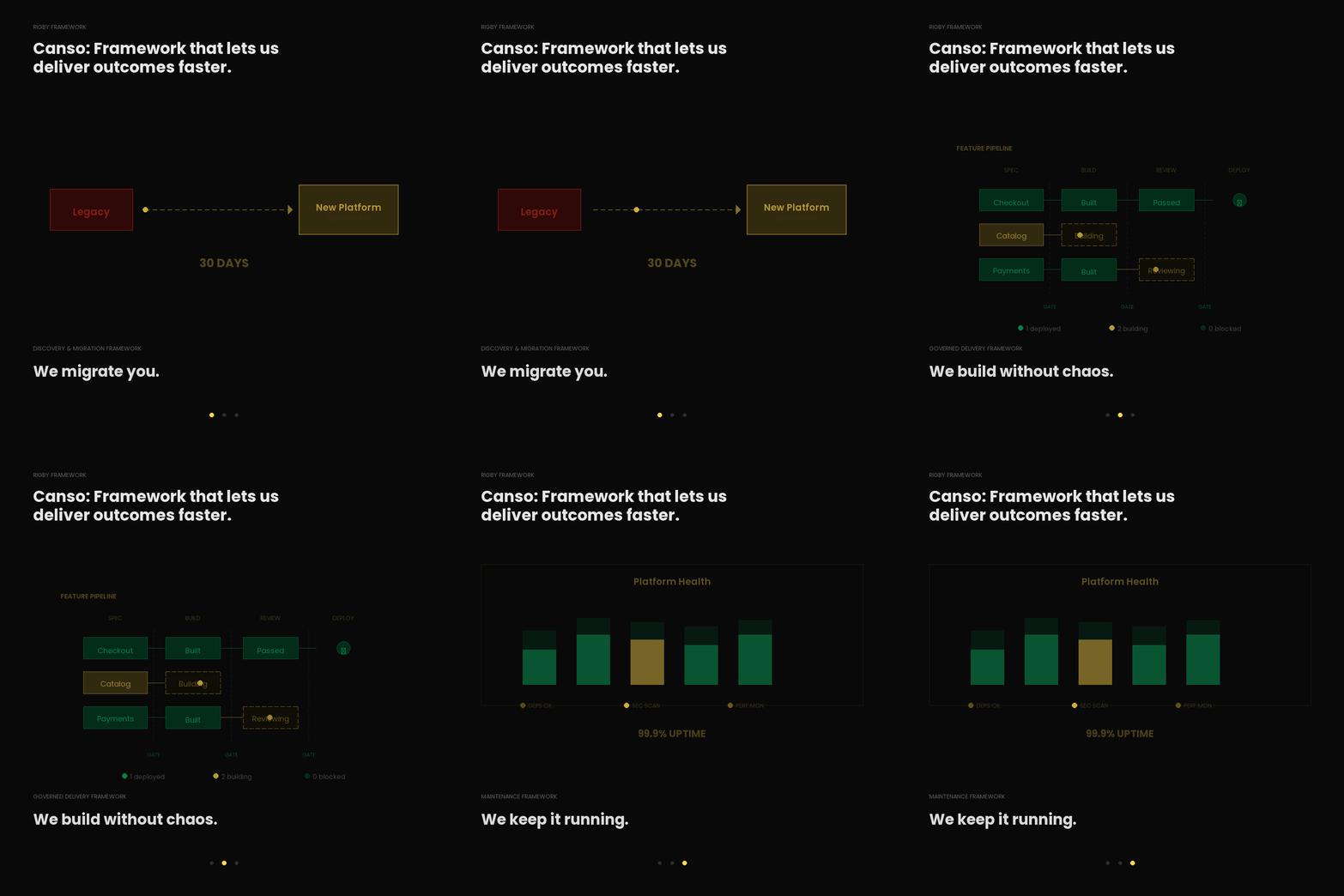
Canso has three pillars. Each one maps to a phase of the commerce platform lifecycle.
Discovery & Migration – 30 days, not 12 months
The first pillar handles the hardest part: getting off the old platform.
Traditional commerce migrations are multi-year programs. They start with a six-month discovery phase, produce a 200-page requirements document nobody fully reads, and then enter an 18-month build cycle that drifts from the original scope by month four. By the time the new platform launches, the business requirements have changed twice.
Canso compresses this. The Discovery & Migration framework uses automated architecture scanning to map the existing platform. It scores migration risk at the module level and produces a staged migration plan with a rollback strategy before a single line of new code is written.
Governed Delivery – AI with guardrails, not chaos
The second pillar is where AI-native delivery becomes concrete.
Governed Delivery means every feature moves through a defined pipeline: Spec → Build → Review → Deploy. AI accelerates each stage, but experienced commerce engineers control the gates that decide what advances.
The result: AI-accelerated development with governance. Feature lead times drop from months to days because the overhead between "we know what to build" and "it's in production" shrinks dramatically.
Maintenance – your platform stays healthy after launch
Most commerce agencies disappear after launch. The project ends, the retainer starts, and maintenance becomes a reactive cycle of Slack messages and emergency hotfixes.
Canso's third pillar treats maintenance as a first-class engineering discipline.
The Maintenance framework provides automated dependency updates, continuous security scanning, performance monitoring, AI-driven incident analysis, and cost optimization insights.
The goal is operational predictability for open-source commerce. Your platform doesn't just launch well, it stays well.
See how Canso works or book demo session!

FAQ on AI-native commerce delivery
What is Canso?
Canso is Rigby's operational framework for AI-native commerce delivery. It covers three phases – Discovery & Migration, Governed Delivery, and Maintenance – and combines AI-assisted engineering with spec-driven development, reusable commerce components, and delivery playbooks built from 30+ enterprise commerce and marketplace projects. See how Canso works or book demo session!
How is AI-native delivery different from using AI coding tools?
AI coding tools speed up individual developers. AI-native delivery embeds artificial intelligence into the entire delivery process: architecture audits, migration planning, spec-driven code generation, automated testing, and post-launch maintenance. The difference is that AI operates inside defined guardrails, not as an ad hoc productivity hack.
How long does a Canso migration take?
The target is 30 days from legacy commerce to a modern, open-source platform built on Medusa or Mercur. That includes automated architecture scanning, dependency mapping, risk scoring, staged migration with rollback strategy, and data model extraction. See how Canso works or book demo session!
What platforms does Canso migrate from?
Canso is designed for migrations from legacy monoliths, like Mirakl, Magento, SAP Commerce, custom-built platforms, and aging Shopify Plus setups that have outgrown the platform's constraints. The target architecture is Medusa for headless commerce and Mercur for multi-vendor marketplace use cases. You own the code after migration – no proprietary lock-in at the platform level. See how Canso works or book demo session!
What does AI-native mean?
AI-native describes a delivery model where artificial intelligence is embedded into the structure of how software gets built, shipped, and maintained.
In commerce delivery, that means AI participates in architecture audits, generates code from structured specs, runs automated test suites, and monitors production systems post-launch.
An AI-native company designs its processes, tooling, and quality gates around AI as infrastructure, the same way a modern warehouse is designed around robotics rather than adding a robot to a manual line.
What is AI commerce?
AI commerce refers to the use of artificial intelligence across the full lifecycle of a commerce platform. Where traditional eCommerce relies on manual configuration and developer-driven changes, AI commerce systems automate estimation, code generation, testing, deployment, and post-launch monitoring.