Let’s talk about how we can build your commerce project — tailored to your business, powered by Rigby
The global B2B eCommerce market is projected to hit $36 trillion in 2026, growing at a 14.5% CAGR and dwarfing B2C by a factor of five. That growth has already translated into structural change: more than 80% of B2B sales interactions happen through digital channels.
Digital commerce now carries a significant share of enterprise revenue. Yet the B2B eCommerce platforms powering this shift have not kept up.
75% of B2B buyers say they would switch suppliers for a better digital experience. That means you constantly balance what buyers expect against what your platform (and your internal resources) can realistically support.
Platform selection defines how your pricing logic operates, how ERP data flows, how approvals are enforced, and how much custom development builds up over time. Every decision involves trade-offs between commercial ambition and technical constraints, with consequences that extend well beyond the initial launch.
This guide was built to bring structure to that decision. It provides a practical, data-driven B2B eCommerce platforms comparison.
We wrote it for people who make or influence platform decisions: CTOs evaluating architecture risk, product leaders trying to ship a roadmap without being blocked by the platform, and digital transformation managers who need to justify the investment.
You will compare the real cost of top B2B eCommerce platforms: the true total cost of ownership, including integrations, custom development, migration, and the operational overhead that never shows up in vendor pricing discussions.
The core of this guide breaks down the most common platform problems we see across the market:
- B2B features locked behind enterprise tiers.
- SaaS constraints that block deep customization.
- Performance degradation under extensions.
- API fragmentation that weakens integrations.
- ERP sync failures that create operational chaos.
- Approval workflows requiring custom development.
- Pricing and payment terms that are not truly native.
Each problem is examined across platforms, not as a vendor review but as a structural pattern that appears under different architectures and pricing models.
In the upcoming chapters, we analyze how Shopify, Adobe Commerce, OroCommerce, and BigCommerce behave in each of these areas under real B2B conditions.
The analysis references user feedback from our workshops and communities (G2, Capterra, TrustRadius, and Reddit) to reflect how these platforms behave in production environments.
Let's start with the basics.
Key takeaways
- The mid-market companies ($10M-$500M in annual revenue) are forced to choose between platforms that are too simple and platforms that are too expensive.
- 83% of B2B buyers prefer digital channels for ordering and paying, and 75% prefer a completely rep-free buying experience.
- Architectural model of the platform determines how far you can customize pricing, workflows, and integrations – and how much control you retain over cost and roadmap.
- Platform evaluation in B2B determines how your pricing logic, approval structure, ERP synchronization, and financial controls will operate. Use simple checklist to identify architectural risks before committing to a multi-year platform decision.
- Many organizations default to the most popular B2B platforms, only to discover structural constraints after implementation begins - check out our platform comparison matrix.
- Choosing the right B2B eCommerce platform is less about comparing brand names and more about matching architecture to your commercial model - you can do it in only 6 steps.
What is the state of the B2B eCommerce market, and what do B2B buyers expect in 2026?
If your business generates $10M-$500M in annual revenue, you already feel the tension.
You have outgrown the SMB tools. Shopify's standard plans cannot handle your approval chains, your customer-specific pricing, or your ERP sync requirements. But the jump to Shopify Plus starts at $2,300/month under a multi-year commitment – nearly 8x more than Advanced plans – and even then, parts of the B2B feature set remain limited.
On the other end, enterprise platforms like Adobe Commerce (Magento) or OroCommerce offer deeper B2B capabilities – but with annual licensing typically starting around $22,000 and scaling beyond $125,000 depending on GMV + full implementation costs commonly reported in the six-figure range, often exceeding $150,000-$200,000 (Source).
For a mid-market business, that kind of commitment means betting the entire roadmap on a single vendor.
The result is a market where mid-market companies are forced to choose between platforms that are too simple and platforms that are too expensive.
There is no good middle option – and that is the core problem this guide addresses.
At the same time, your buyers have changed.
71% of B2B procurement professionals are now millennials and Gen Z, who grew up with Amazon, not fax machines. They expect self-service portals, real-time inventory, instant pricing, and mobile-first interfaces. 83% of B2B buyers prefer digital channels for ordering and paying, and 75% prefer a completely rep-free buying experience.
However, the complexity behind those transactions has not decreased. The average B2B purchase involves 6-8 stakeholders, each with different roles, permissions, and approval authority.
In B2C, an eCommerce platform manages individual customer accounts, public pricing, and direct payment. In B2B eCommerce, the platform has to model organizational structures, negotiated agreements, and operational controls across multiple business systems.
Below is a simplified comparison focused on business structure that shows why enterprise B2B eCommerce platforms require deeper architecture, pricing logic, workflow engines, and integration capabilities.
Now, you need to support company role-based access, configurable approval workflows, customer-specific catalogs, and payment terms (Net 30/60/90) built into the checkout flow. All of it is native, out of the box, without relying on third-party apps or "available on request" workarounds.
If these foundations are missing, the consequences show up immediately in buyer behavior (Source):
- 55% of B2B buyers want to see their personalized, agreed-upon prices.
- 49% want to see their personalized agreed payment rules.
- 47% want to see their personalized agreed logistical rules.
- 40% want accurate information on stock, pricing, and delivery dates.
- 37% want access to order status, order history, and outstanding invoices.
- 35% want a full product range catalog available.
These are baseline expectations tied to existing commercial agreements. When those elements are inconsistent, confidence drops, and purchasing shifts back to alternative suppliers.
What is a B2B eCommerce platform?
A B2B (business-to-business) eCommerce platform is a system that lets your company sell to other companies, but its role goes far beyond displaying products and processing payments.
When you operate in B2B, every transaction reflects a commercial relationship that already exists:
- Your business customers are companies structured into departments, roles, and approval levels.
- Pricing is negotiated and often varies by contract, volume, or region.
- Payment does not always happen at checkout, but according to agreed terms, such as Net 30 or Net 60.
The platform has to represent these rules accurately every time a business buyer logs in, builds a cart, and places an order. This also means the platform sits in the middle of your operational systems:
- Pricing and credit limits may originate in the ERP.
- Product data may be managed in a PIM.
- Account ownership and sales history may live in your CRM.
Orders must move across these systems without breaking consistency in pricing, inventory, or financial data. If the platform cannot reflect how these systems interact, the gap is filled with manual reconciliation and custom fixes.
Understanding this structural role is the starting point for evaluating any B2B eCommerce platform. Before comparing vendors, you need clarity on what the system is actually expected to model inside your organization.
We break down B2B buyers, products, and the digital sphere in details in Chapter 2 of this guide!
Differences between B2B and B2C in eCommerce
Many platform discussions start with features. The real difference starts earlier – in how the business operates.
When you map these differences to architecture, the implications become clear:
- If your business runs on negotiated contracts, your pricing engine cannot rely on simple discount rules.
- If your business users purchase through internal approval chains, your checkout cannot remain linear.
- If your finance team manages credit exposure in the ERP, your platform cannot treat payment as a standalone step.
- If inventory lives in multiple warehouses, batch sync is not enough.
This is why many platforms struggle as B2B complexity grows. They may support parts of this model, but not all of it natively.
We expand on these operational and architectural implications in Chapter 3: B2B vs B2C Ecommerce: Top 5 Differences, Features & Why They Matter (2026 Data)
What are the types of B2B eCommerce platforms?
When you compare B2B eCommerce platforms, the biggest differences are not in feature lists but in the architectural model. It determines how far you can customize pricing, workflows, and integrations – and how much control you retain over cost and roadmap.
Most enterprise B2B eCommerce solutions fall into four structural categories. Choose a model that fits the needed level of control, integration depth, pricing logic flexibility, and long-term cost exposure.
1. SaaS-first platforms
Examples: Shopify, BigCommerce.
These platforms are fully managed by the vendor. Hosting, upgrades, and core infrastructure are handled for you. Deployment is typically faster, and subscription pricing is predictable.
Trade-offs:
- Limited control over core architecture.
- Checkout and workflow customization boundaries.
- Advanced B2B features often restricted to higher tiers.
- Heavy reliance on third-party apps for complex requirements.
SaaS platforms work well when your B2B eCommerce strategy prioritizes speed and lower operational overhead.
They become restrictive when you need deep pricing logic, complex approval workflows, or custom ERP integration patterns.
2. Open-source
Examples: Adobe Commerce (Magento), OroCommerce.
These platforms give you direct control over the application layer. You can modify data models, pricing engines, checkout logic, and integrations without vendor-imposed constraints.
Trade-offs:
- Higher implementation costs.
- Longer deployment timelines.
- Ongoing maintenance responsibility.
- Upgrade complexity.
Open-source models provide flexibility for complex enterprise B2B eCommerce platforms, especially when contract pricing, custom catalogs, and workflow control are central to your business.
The cost is higher technical ownership and operational burden.
3. ERP-centric platforms
Examples: SAP Commerce Cloud, Microsoft Dynamics 365 Commerce.
In this model, the eCommerce platform is closely aligned with the ERP system. Pricing, inventory, financial rules, and customer data often originate in ERP and flow directly into the storefront.
Trade-offs:
- Strong integration with internal systems.
- High dependency on ERP architecture.
- Longer implementation cycles.
- Limited agility outside the ERP ecosystem.
This approach works well when your organization is already deeply invested in a specific ERP system and wants commerce tightly aligned with financial and operational processes. It can reduce integration risk but increase vendor dependency.
4. Composable/API-first platforms
Examples: Headless or modular commerce stacks.
Here, eCommerce is built as a set of services connected through APIs. You assemble pricing, checkout, catalog, and order management components into a tailored architecture.
Trade-offs:
- High flexibility.
- Greater architectural responsibility.
- Requires strong internal technical capacity.
- More complex vendor coordination.
Composable models allow you to design around specific B2B requirements, such as advanced pricing logic or custom approval workflows. They also shift more architectural decision-making and integration accountability to your team.
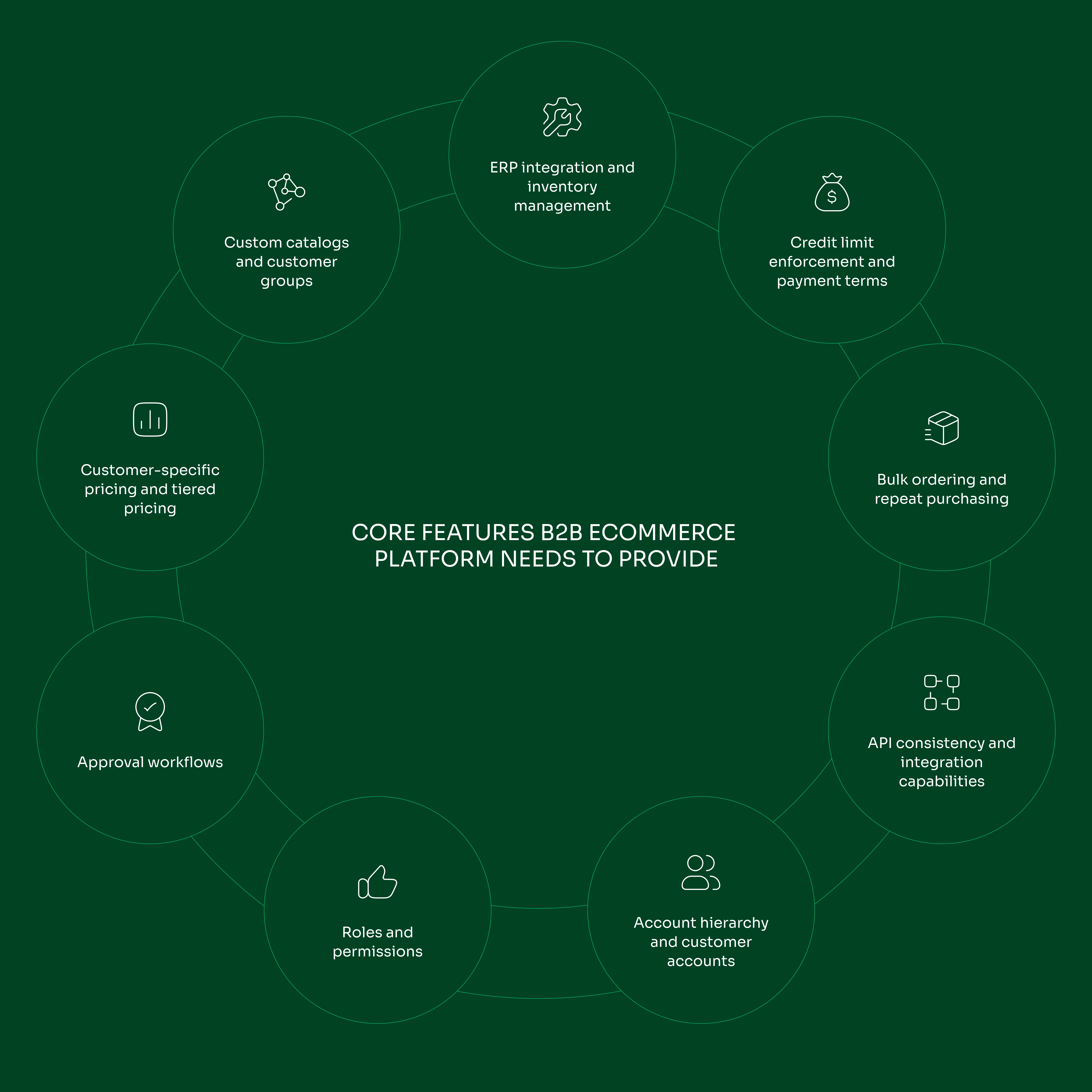
9 core features your B2B eCommerce platform needs to provide
Every eCommerce platform supports core functionality, such as product pages, cart, checkout, and payment processing. That level of functionality is enough when you sell directly to individual consumers.
In B2B eCommerce, the requirements go further. Your business customers operate under contracts, internal approval rules, negotiated pricing, and payment terms. Your sales process connects to ERP and CRM systems.
Below are the core features a B2B eCommerce platform needs to support in enterprise environments.
Explore all B2B feature requirements in Chapter 3!
Account hierarchy and customer accounts
Your platform must support structured customer accounts representing real company structures. This includes parent-child account relationships, multiple users per company, and location-based access.
For you, this means accurate reporting and budget control by branch or department. For business buyers, it means they can operate within their internal structure without workarounds.
Roles and permissions
B2B buying often involves multiple stakeholders. Your platform must allow granular role-based access.
You should be able to define who can place orders, who can approve them, who can view pricing, and who can access invoices.
For your business, this enforces governance and compliance. For your customers, it mirrors their internal purchasing policies.
Approval workflows
Approval workflows are central to business-to-business transactions. Orders may require approval based on order value, product category, or department. A B2B eCommerce platform must route these approvals automatically inside the system.
For you, this protects margins and enforces internal controls. For buyers, it ensures purchasing policies are respected without slowing down the sales process.
Customer-specific pricing and tiered pricing
In B2B eCommerce, pricing is rarely universal. Your platform must support negotiated pricing, tiered pricing, and customer-specific pricing rules at the account level.
For your business, this protects contract agreements and prevents pricing disputes. For customers, it ensures that what they see online matches what was agreed offline.
Custom catalogs and customer groups
Not every business customer should see the same product range. A modern B2B eCommerce platform must allow customer-specific catalogs and visibility rules tied to contracts or regions.
This allows you to manage multiple brands and product assortments across sales channels. For buyers, it simplifies the purchasing experience and reduces errors.
ERP integration and inventory management
Your platform must synchronize pricing, inventory management, credit limits, and financial data with ERP systems.
Without reliable ERP integration, order processing errors increase, and customer satisfaction declines.
Credit limit enforcement and payment terms
Many business customers operate under payment terms, such as Net 30 or Net 60. Your B2B eCommerce platform must validate credit limits and enforce payment terms during checkout.
For your finance team, this protects cash flow and reduces risk. For buyers, it ensures the consistent application of agreed commercial rules.
Bulk ordering and repeat purchasing
Business buyers often place large or recurring orders. The platform should support bulk ordering, quick-order forms, saved carts, and easy reordering from purchase history.
This improves the customer experience and reduces friction in the sales process, especially for existing customers placing frequent orders.
API consistency and integration capabilities
A modern eCommerce platform must offer strong integration capabilities. Consistent APIs allow you to connect third-party tools, marketing tools, CRM systems, and other business systems.
Without stable APIs, custom development increases and integration reliability decreases over time.
How to evaluate B2B eCommerce platforms in 2026 (Checklist of requirements)
Platform evaluation in B2B determines how your pricing logic, approval structure, ERP synchronization, and financial controls will operate for years.
Their risks rarely appear during the demo. The gaps usually appear after launch when business operations and workflows start interacting under load.
The checklist below reflects the criteria to use when assessing B2B eCommerce platforms. Each dimension maps directly to how your commercial agreements and operational systems function day to day.
Use it to pressure-test vendor claims, structure internal evaluation workshops, and identify architectural risks before committing to a multi-year platform decision.
1. Account hierarchy
Can the platform model company structures with multiple entities, locations, and departments?
You should be able to define relationships between accounts, assign users to specific branches, and restrict ordering by location or cost center.
If hierarchy is limited to simple customer groups, you will not be able to separate budgets by branch, control purchasing per department, or generate accurate reporting at the account level.
2. Roles and permissions
Does the platform support granular, configurable, role-based access?
You should be able to define who can place orders, approve carts, access invoices, manage users, or view pricing.
If permissions are rigid or hard-coded, you will either grant excessive access or move approval control outside the system.
3. Approval workflows
Are approval workflows configurable based on order value, product category, or department?
You should be able to route orders automatically to managers or compliance roles depending on predefined rules.
If approval logic is limited, high-value orders will bypass internal controls, or approvals will move to email and spreadsheets.
4. Customer-specific pricing and payment terms
Can the platform enforce negotiated pricing and payment terms natively?
You should be able to apply contract pricing, tiered pricing, volume rules, and payment terms.
If pricing depends on static price lists or batch ERP updates, customers will see incorrect prices, and finance teams will issue manual corrections.
5. ERP integration
How tightly does the platform integrate with your ERP system?
Pricing, inventory, credit limits, and financial data should sync reliably and predictably.
If integration relies on unstable or delayed synchronization, inventory discrepancies and pricing errors will affect live orders.
6. Catalogue complexity
Can the system manage segmented and customer-specific catalogs?
You should be able to restrict product visibility by contract, region, or customer group.
If catalog segmentation is shallow, restricted products may become visible, or contracted assortments cannot be enforced.
7. API consistency
Is the API surface coherent and complete for both read and write operations?
You should be able to extend workflows and integrations without database-level workarounds.
If APIs are fragmented, custom integrations will break during upgrades or require unsupported endpoints.
8. Performance at scale
How does the platform perform with large baskets and complex pricing rules?
You should test carts with 50–200+ line items and real-time pricing recalculations.
If pricing resolution slows under load, bulk ordering becomes unusable, and sales teams revert to manual order entry.
9. Multi-warehouse inventory
Does the platform support warehouse-level inventory logic?
You should be able to reflect stock by location and calculate realistic delivery timelines.
If inventory is aggregated without warehouse logic, orders may route incorrectly, and delivery dates will be inaccurate.
10. Credit limit enforcement
Can the platform validate credit limits in real time during checkout?
Credit exposure and outstanding balances should influence whether an order can be placed.
If credit validation happens outside the platform, orders may exceed approved limits, and shipments will be blocked post-purchase.
Top B2B eCommerce platforms comparison & where they fall short

For this enterprise B2B eCommerce platform comparison, we selected four widely adopted platforms: Shopify, Magento (Adobe Commerce), OroCommerce, and BigCommerce. These platforms frequently appear in shortlists for enterprise and upper mid-market B2B projects.
The goal is not to rank vendors but to show that popularity and brand recognition do not automatically translate into architectural fit for enterprise B2B complexity. Many organizations default to the most visible vendors, only to discover structural constraints after implementation begins.
Below is a structural B2B eCommerce platform comparison focused on architecture, B2B depth, integration model, and operational constraints.
Each platform will then be examined in greater technical detail in the following chapters, where we analyze pricing engines, B2B features, ERP integration patterns, API consistency, and more.
Comparison matrix of 4 the most popular B2B platforms (enterprise focus)
Shopify

Shopify as a core platform is built primarily for B2C commerce. Standard Shopify plans do not include advanced B2B features, those capabilities are available only in Shopify Plus.
When you operate on non-Plus plans, B2B functionality typically depends on third-party apps. On Shopify Plus, B2B features are integrated but still operate within the constraints of a SaaS architecture.
Where it works well
- Companies with standardized pricing models
- Teams without large internal engineering capacity
- Businesses prioritizing speed and operational simplicity
Where it falls short
- Complex multi-level approval workflows
- Advanced negotiated pricing logic
- Heavy customization of checkout and workflow logic
Hidden trade-off
- You gain operational simplicity and predictable subscription pricing.
- As B2B complexity increases, dependency on apps and middleware increases.
- Architectural control remains limited compared to open-source or composable models.
Magento (Adobe Commerce)

Adobe Commerce (previously known as Magento Commerce), is enterprise-focused eCommerce platform built to support both B2C and B2B operations. Alongside it, Magento Open Source remains available as a self-managed version, but it does not include native B2B functionality.
Adobe Commerce is positioned as a cloud-ready, enterprise-grade platform with deeper native B2B capabilities compared to the open-source version, but access to those features requires a SaaS/PaaS license. In B2B it offers company accounts, purchase approvals, quoting, requisition lists, and payment on credit.
Where it works well
- Contract-heavy B2B environments
- Multi-brand operations
- ERP-centric pricing and inventory models
Where it falls short
- High implementation cost
- Ongoing developer dependency
- Upgrade complexity with heavy customization
Hidden trade-off
You gain flexibility and deep customization. In exchange, you assume long-term technical ownership and higher maintenance costs.
OroCommerce

OroCommerce was designed specifically for B2B eCommerce. Account hierarchy, approval workflows, and pricing logic are built into the core architecture. Its architecture aligns well with ERP-centric environments and complex contract-driven models.
Where it works well
- Manufacturers and distributors
- Contract-level pricing complexity
- Deep customer-specific catalog requirements
Where it falls short
- Smaller ecosystem compared to Shopify or Adobe
- Fewer off-the-shelf integrations
- Higher reliance on specialized partners
Hidden trade-off
You gain native B2B depth. However, you operate within a narrower ecosystem and require stronger technical coordination.
BigCommerce

BigCommerce provides core eCommerce functionality through a SaaS model. What's more, it automatically upgrades your subscription plan when your trailing 12-month online revenue exceeds the plan ceiling.
Advanced B2B features are delivered via its B2B Edition, but you must be on Enterprise tier.
Where it works well
- Structured B2B with moderate pricing complexity
- Businesses managing customer groups and basic approval rules
- Companies preferring SaaS governance
Where it falls short
- Deep multi-level workflow customization
- Highly complex negotiated pricing logic
- Advanced ERP-driven orchestration
Hidden trade-off
Operational overhead is lower than open-source platforms. Architectural flexibility is also lower when contract and workflow complexity increase.
Where most B2B eCommerce platforms fall short
Enterprise B2B eCommerce platforms rarely fail because of a single missing feature. Limitations usually emerge at the intersection of pricing logic, approval workflows, ERP integration, and performance under scale.
This section highlights the recurring constraint patterns observed across leading vendors. It sets the context for a deeper evaluation.
In the next chapters of this guide, we move from high-level comparison to detailed technical analysis.
Each of the shortlisted platforms – Shopify, Adobe Commerce, OroCommerce, and BigCommerce – will be analyzed against real B2B operating conditions: contract pricing, approval chains, ERP synchronization, API behavior, and more.
1. B2B features restricted to higher tiers
Advanced capabilities, such as company account hierarchy, approval workflows, or customer-specific pricing, are often available only in enterprise plans. This changes total cost assumptions and limits flexibility during scaling.
2. Limited customization due to SaaS model constraints
SaaS-first platforms restrict access to core architecture. Even when APIs are available, deep workflow or pricing changes may not be possible without workarounds.
3. Performance degradation with bulk ordering
Large baskets (50–200+ SKUs) combined with contract pricing and ERP calls expose architectural bottlenecks. Cart recalculations slow down, and order processing latency increases.
4. Fragmented APIs limiting automation
Incomplete or inconsistent API coverage restricts integration with CRM systems, marketing tools, and other business systems. Automation becomes fragile, especially during platform upgrades.
5. ERP integration that weakens under scale
Demo environments typically show clean synchronization. In production, delayed sync, partial failures, and reconciliation gaps appear when pricing, inventory, and credit validation interact simultaneously.
6. Approval workflows that require customization
Many platforms support basic approvals, but multi-level routing based on value, department, or product category frequently requires custom development or third-party extensions.
7. Pricing engines under contract complexity
Layered negotiated pricing, tiered pricing, volume commitments, and promotional logic often conflict. Platforms that rely on simplified rule engines struggle when multiple pricing conditions must be resolved in real time.
How to choose the right B2B eCommerce platform in 6 steps?

Choosing the right B2B eCommerce platform is less about comparing brand names and more about matching architecture to your commercial model.
Start with your business reality: how you price, how you approve orders, how you manage inventory, and how tightly your eCommerce website connects to ERP and CRM systems.
Below is a structured way to evaluate which B2B eCommerce platform fits your organization.
1. Map your commercial complexity first
Before looking at vendors, define:
- Do you operate with negotiated pricing or tiered pricing?
- Do business customers require approval workflows?
- Do you support customer-specific catalogs?
- Are payment terms such as Net 30 or Net 60 standard?
- Do you manage multiple brands or regional entities?
If your sales process is contract-driven and pricing is dynamic, you need a platform with deep native B2B capabilities. If pricing is standardized and approval logic is minimal, a lighter architecture may be sufficient.
2. Define your system dependencies
Your B2B eCommerce platform will sit inside a network of business systems. Clarify:
- Is ERP integration central to pricing and inventory management?
- Does data originate in customer relationship management systems?
- Are there other systems that must synchronize in real time and streamline operations?
If your ERP systems act as the source of truth for pricing, credit limits, and inventory, seamless integration capabilities should be a primary selection criterion.
3. Assess your internal technical capacity
Different platform models require different levels of ownership.
- SaaS platforms reduce infrastructure responsibility but limit deep customization.
- Open-source and composable models offer flexibility but require significant technical expertise.
Your internal engineering capacity, or reliance on external partners, will influence which architecture is sustainable over time.
4. Evaluate long-term operational impact
Platform decisions affect business operations for years. Consider:
- How will pricing changes be managed?
- How will approval workflows evolve?
- How will new markets or multiple brands be added?
- How will customer experience scale as order volume increases?
The right eCommerce platform should support growth without requiring constant custom development or increasing operational complexity.
5. Run scenario-based validation
During vendor evaluation:
- Test bulk ordering scenarios
- Simulate layered customer-specific pricing
- Validate ERP synchronization under load
- Review API consistency for automation
Ask vendors to demonstrate real business scenarios, not isolated features.
6. Compare total cost beyond subscription
Pricing structure is only one part of the equation. Include:
- Implementation costs
- Integration development
- Ongoing maintenance
- Extension or third-party app costs
- Upgrade effort
A platform with a lower subscription cost may generate higher operational overhead over three to five years.
A strong decision process focuses on structural fit. When architecture matches your business operations, customer satisfaction improves, operational friction decreases, and the platform becomes a stable foundation for growth rather than a constraint.
Assess your B2B eCommerce platform requirements with B2B eCommerce Experts!
B2B eCommerce platform decisions shape how your pricing, approvals, inventory management, and customer relationships function for years.
Most platform constraints are not visible at the shortlist stage. They appear when negotiated pricing, approval chains, and ERP systems begin operating together under real order volume.
That is why platform selection should start with your operating model and system architecture, not with vendor popularity.
If you would like to assess your B2B eCommerce platform requirements before committing to a vendor decision – schedule a free workshop with our B2B eCommerce Experts!
Together we will determine which architecture model and technology stack align with your specific business requirements.
FAQ on B2B eCommerce platforms
How do I select the right B2B eCommerce platform for my business?
To select the right eCommerce platform for your business, start by evaluating how each platform handles customer accounts, customer-specific pricing, tiered pricing, bulk ordering, and approval workflows.
A structured B2B eCommerce platform comparison should evaluate integration capabilities with ERP and CRM systems, including how customer data, inventory management, and order processing synchronize across business systems.
If your business operates across multiple brands or regions, assess how the eCommerce platform supports managing multiple brands, custom catalogs, and customer groups.
The right eCommerce platform is the one that supports your sales process, integrates with existing systems, and scales with your business operations without requiring constant custom development or third-party apps.
What are the benefits of selling on a B2B eCommerce platform?
Selling through a B2B eCommerce platform supports both revenue growth and operational control:
- Higher customer loyalty through access to customer-specific pricing, negotiated pricing, order history, and self-service capabilities.
- Stronger customer relationships by aligning the eCommerce site with how business buyers actually purchase.
- Reduced manual work for sales teams and sales reps, allowing them to focus on strategic accounts instead of order entry.
- More accurate pricing and margin control with structured custom pricing and tiered pricing enforcement.
- Improved inventory management and order processing through reliable ERP integration.
- Better visibility into customer data and sales data, supporting data-driven decisions.
- Scalability across multiple brands, sales channels, and new markets without duplicating business systems.
What types of companies need a B2B eCommerce platform?
Any company that sells products or services to other businesses and manages intricate customer relationships should consider a B2B eCommerce platform.
If your sales process includes negotiated pricing, custom pricing models, customer-specific catalogs, or credit terms, a generic eCommerce store will create operational friction.
This includes manufacturers, distributors, wholesalers, and companies operating across multiple brands or new markets. Companies integrating eCommerce with ERP systems, CRM platforms, and other business systems benefit most from a customized eCommerce solution.
Which eCommerce platform is best for B2B?
The best B2B eCommerce platform for your organization depends on how complex your pricing logic is, how tightly you rely on ERP and CRM systems, and how much technical capacity you have internally.
SaaS-first platforms may offer faster deployment and simpler maintenance. Open-source or ERP-heavy models provide deeper control but require significant technical expertise and ongoing custom development.
What are the must-have B2B features of an enterprise eCommerce platform?
An enterprise B2B eCommerce platform must support customer accounts with role-based access, configurable approval workflows, and customer-specific pricing models.
Custom catalogs, negotiated pricing, tiered pricing, and bulk ordering are foundational for enhancing customer satisfaction.
ERP integration is enabling businesses to have accurate inventory management, credit limit enforcement, and financial reconciliation.
The platform should connect reliably with CRM systems, digital marketing tools, and other business systems to maintain consistent customer data.
Strong API consistency, flexible integration capabilities, and support for managing multiple brands allow the eCommerce platform to expand globally and adapt to new markets.
Without these essential features, B2B online stores rely heavily on third-party tools and manual processes, which increases operational costs and limits business success.