
+30% Checkout Conversion after Migration from Shopify Plus to Medusa for a Health Subscription Brand
Healthletic partnered with us to migrate from Shopify Plus to Medusa. Our solution lifted checkout conversion +30% on a $24M+ yearly GMV business, without disrupting fulfillment or existing subscribers.
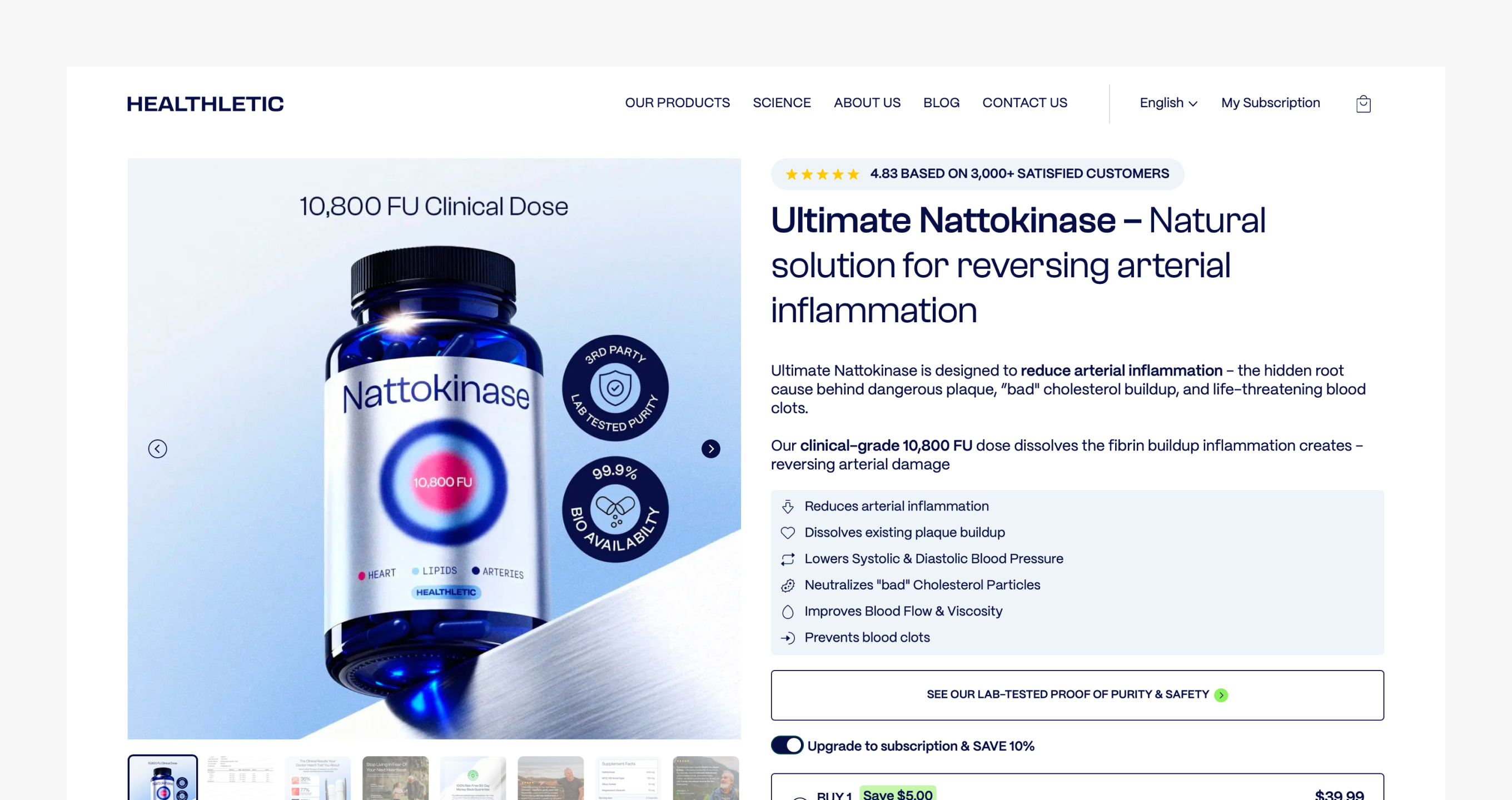


Client
Healthletic is a Lithuania-headquartered D2C brand that sells dietary supplements & wellness formulas, available as one-time purchases and recurring subscriptions. The business draws around 3,8M+ visitors and 240,000+ orders in a year, for an estimated $24M+ in yearly GMV.
It's live across six markets, with the US carrying roughly 70% of volume alongside the UK, Australia, Canada, South Korea, and France.
- Hybrid model: Medusa commerce engine, Shopify remains as a bridge for old subscriptions and fulfillment
- Proxy login recognizes returning Shopify customers automatically
- Native subscription commerce built into checkout
Download case study
yearly GMV
orders a year
checkout conversion after migration
Problems

Challenge
Healthletic was running on Shopify Plus, paying 25,000 USD a month in total. At 240,000+ orders a year, those fees took a growing cut of every sale.
The brand wanted a cheaper and more flexible platform, but switching meant putting its subscription business at risk, along with every subscriber already billing on it.
Shopify Plus fees limiting growth
Healthletic is processing more than 240,000 orders a year. The Shopify Plus subscription came to 25,000 USD per month, and percentage-based checkout fees ran to 6 times the subscription price on top of it.
Shopify's checkout also ties payment processing to a fixed set of methods and one fee structure. In a subscription business, where the same customer is billed again and again, that cost repeats for the lifetime of each subscription.
Payment options locked to Shopify's checkout
Healthletic's products sell mainly as subscriptions. A single cutover to a new platform risked breaking recurring billing for subscribers already on file, and interrupting checkout while customers were mid-purchase.
The subscription logic was tied to Healthletic's existing fulfillment and support tooling, which made it too complex and too central to the business to migrate one-to-one in a single project. Any new platform had to run alongside the existing setup instead of replacing it outright.
Solutions
We migrated Healthletic's commerce engine to Medusa, running in parallel with the existing Shopify setup. The delivery covered design, storefront, backend, and integrations.
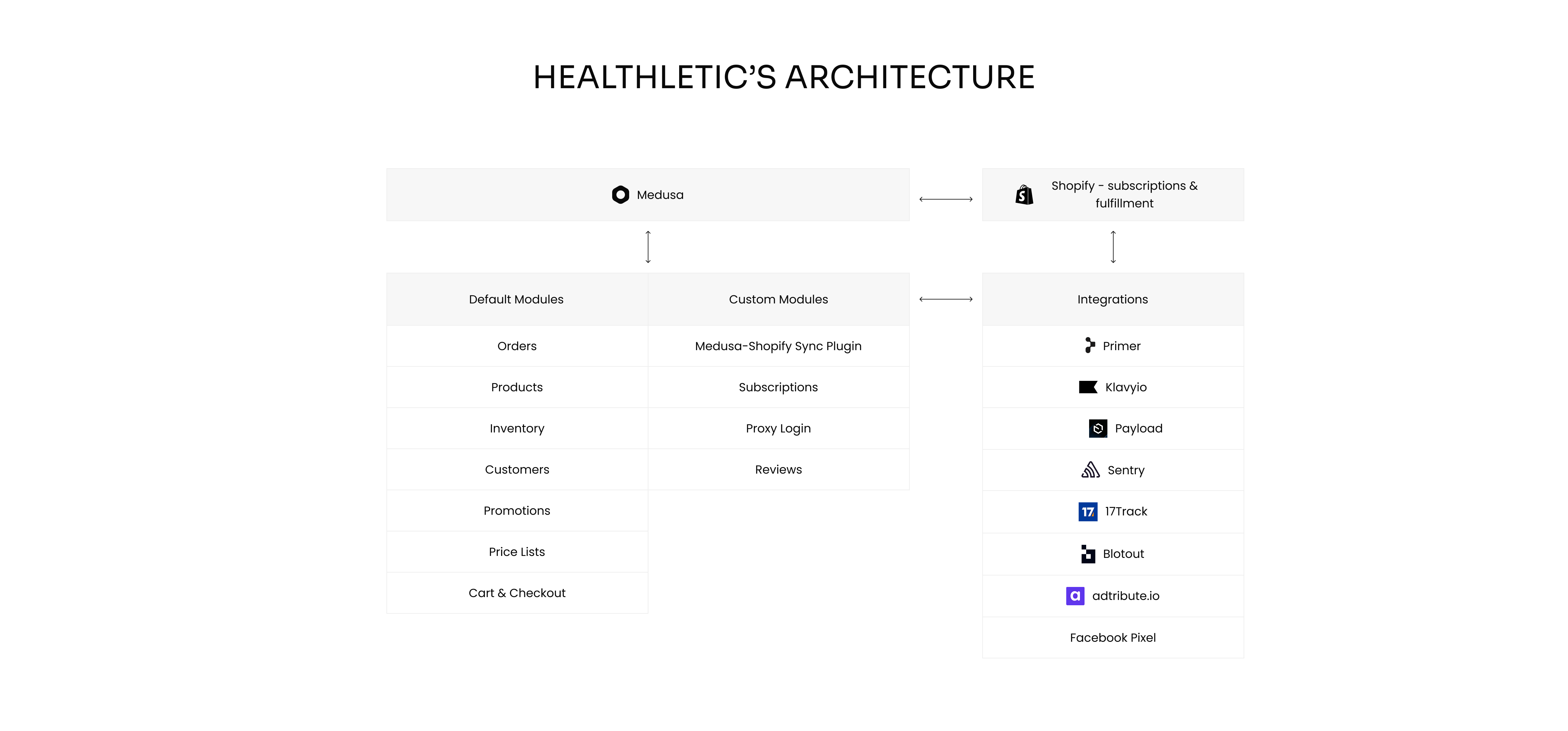
Hybrid architecture: Medusa engine + Shopify for old subscriptions and fulfillment
The new eCommerce platform on Medusa handles checkout and subscriptions directly. A custom Medusa-Shopify Sync Plugin syncs every new order back to Shopify automatically, so the client's existing fulfillment, 3PL, and Commslayer-based support tooling kept working unchanged on their end.
Healthletic moved checkout and new subscriptions onto cheaper, more flexible infrastructure, and nothing on the fulfillment or support side had to be rebuilt to match.
Native subscription commerce
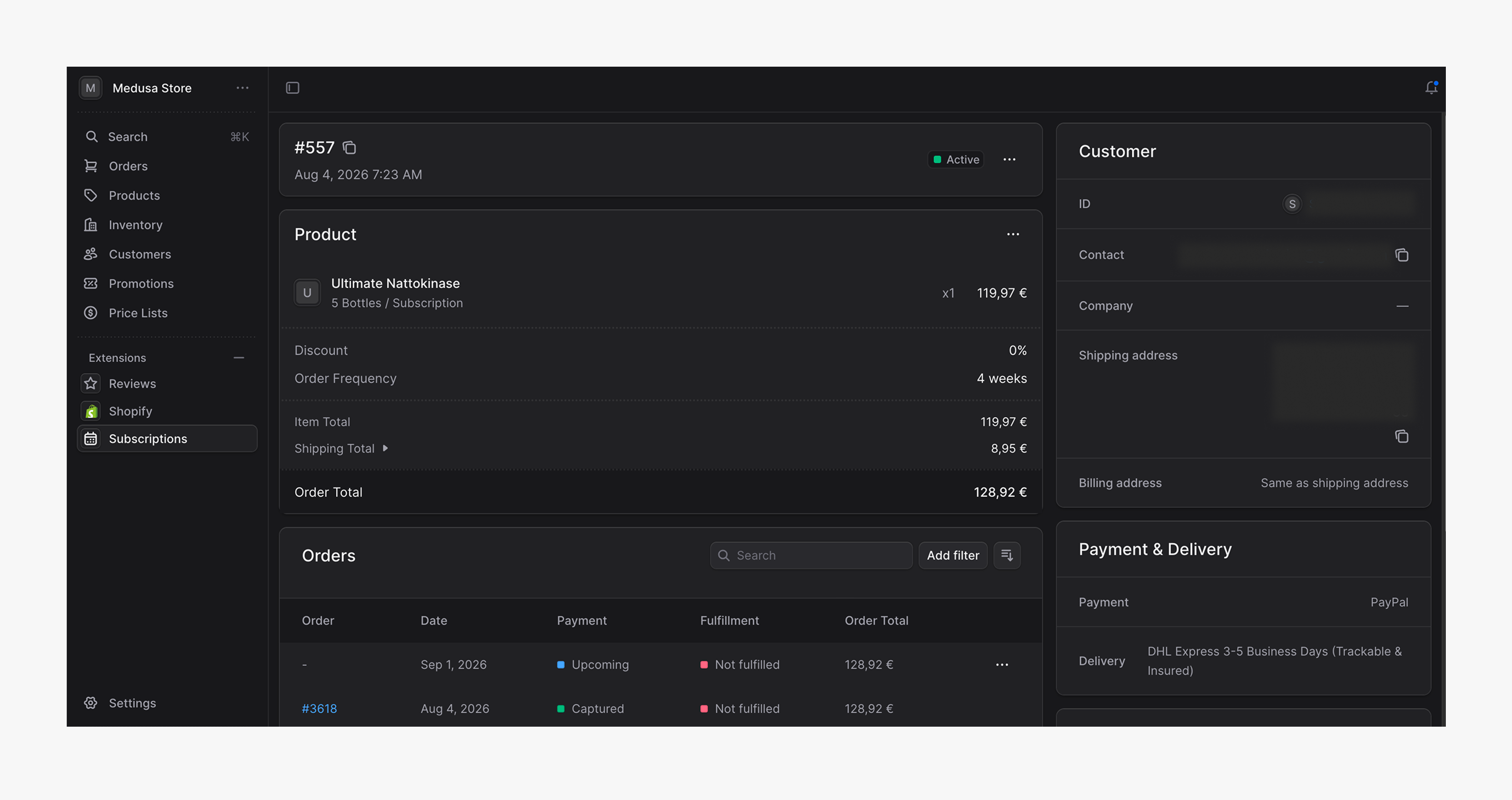
Subscriptions are the core of Healthletic's business. We built the subscription engine as a first-party module inside the Medusa backend, so billing logic, customer controls, and the product catalogue run in one system. The same product sells as a one-time purchase or a subscription, with the choice modelled as a product variant option.
Plans and billing frequency
Subscriptions renew on weekly, monthly, or yearly cadences, each with a number multiplier. Customers change the cadence themselves after subscribing.
Customer self-service
Subscribers manage everything from their account, with no support contact required:
- Pause, resume, or cancel a subscription
- Skip the next order
- Order now, charging and shipping the next order immediately
- Change billing frequency
- Reschedule the next billing date
- Add or swap products on the upcoming order
- Update the payment method, card or PayPal
- Edit shipping details
- Apply a discount code
- View order history and a full activity log of every change
Recurring billing
A scheduled job runs once daily and processes every subscription due that day. Renewals are charged off-session against a securely vaulted payment token, with no customer action. Billing runs across cards, Apple Pay, and Google Pay through Primer, with a native PayPal path alongside. Each renewal order syncs into Shopify for fulfillment and 3PL handling.
Failed payments and dunning
A failed renewal moves the subscription to past-due and starts an automatic retry sequence. The engine makes up to 5 attempts, the first after 3 days and the rest on successive Fridays, with a Klaviyo email at each step. A subscription recovered anywhere in that sequence returns to active on its original renewal date, so a card failure never pushes the billing schedule later. The subscription cancels automatically once all 5 attempts fail.
Reliability
Recurring billing runs unattended, so the engine carries safeguards against double charges, missed runs, and inconsistent state:
- de-duplication holds a customer to one charge per renewal even if the daily job runs twice
- a backup scheduler picks up a missed run, keeping billing days intact through deployments
- payments are authorized in sequence, so a declined card never creates a ghost order
- every subscription change and billing event lands in an audit log
Proxy login for returning Shopify customers
Returning customers with an existing Shopify account are recognized automatically and routed into their legacy account. New customers go through the Medusa account and checkout flow directly. This kept existing subscribers on their original account and subscription history, with no need to log in again during the switch.
Primer payment orchestration
Primer is a payment orchestration platform that sits between checkout and multiple payment methods and processors, rather than tying checkout to a single provider. We integrated Primer to handle PayPal Express, Apple Pay, Google Pay, and card payments, along with refunds, so Healthletic controls how payments are routed. A hosted checkout does not allow that.
The wallets appear twice in the flow, by design. Express, at the top of checkout – PayPal, Apple Pay, and Google Pay sit at the very start. A customer with wallet details already saved can pay before typing anything.
Full payment step at the end – anyone who scrolls past that reaches the standard payment step, where the same three wallets appear again, this time alongside classic card entry.
Payload CMS for marketing-owned content
We connected Payload CMS to the storefront so Healthletic's marketing team can manage the navbar, footer, custom product pages, and blog directly, without filing a development ticket for routine content changes.
Klaviyo for lifecycle email
Klaviyo handles lifecycle and transactional email, including: automated flows, OTP verification, and abandoned cart messages, mapped directly to Medusa customer events.
It is also wired into the storefront. Its onsite tracking captures browsing and cart activity as it happens, which is what makes a feature like abandoned cart possible.
Attribution, monitoring, and order tracking
Blotout, adtribute.io, and Facebook Pixel handle attribution and event tracking across the new storefront. Sentry monitors errors on both frontend and backend, and a 17Track integration powers the storefront's order-tracking experience.
Results
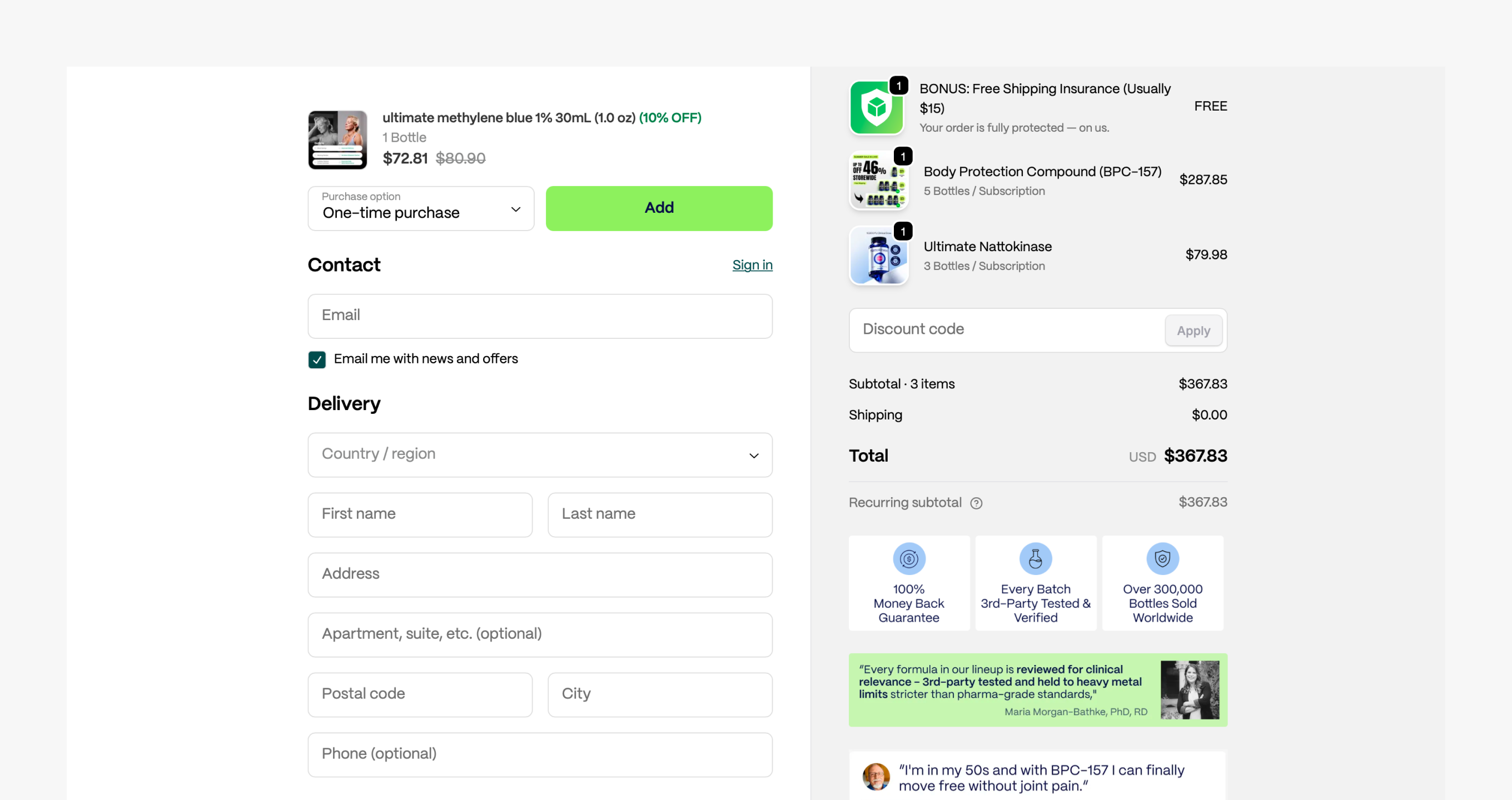
Healthletic is live on Medusa, with the new platform running alongside Shopify as the bridge for legacy subscriptions and fulfillment.
"We see better performance of our Medusa storefront vs Shopify. Seems we can definitely beat Shopify!" – Deividas Daubaris, CEO at Healthletic
+30% checkout conversion after migration
In the first month after migration, checkout conversion is around 30% higher than on Shopify Plus, thanks to more flexible payment options and a headless tech stack. Existing subscribers kept their accounts and billing history through proxy login, with no re-authentication and no gap in recurring billing.
Platform costs no longer rise with every order
Medusa is open source, so Healthletic now only pays to run the platform. Selling more no longer raises the platform bill at the same rate, which changes what growth costs the business.
New stack in place without disrupting or rebuilding operations
Orders placed on the new platform sync automatically from Medusa back into Shopify. The client's fulfillment, 3PL, and Commslayer-based support tooling carry on exactly as before. Healthletic got a new commerce engine without paying for a second project to rebuild the operations around it.


We're happy with the Rigby team. Everyone is smart and business-oriented, and we're looking forward to a long-term partnership.
Let’s build together
Let’s talk about how we can build your commerce project — tailored to your business, powered by Rigby



















Got a commerce
modernization challenge?
Let's talk
A 30-minute Commerce Future Session - tailored to your stack, your challenges, your roadmap. No pitch. Just perspective. No preparation needed on your side.

“Whether you're exploring migration, struggling with legacy complexity, or just want a second opinion - we're here.”