Let’s talk about how we can build your commerce project — tailored to your business, powered by Rigby
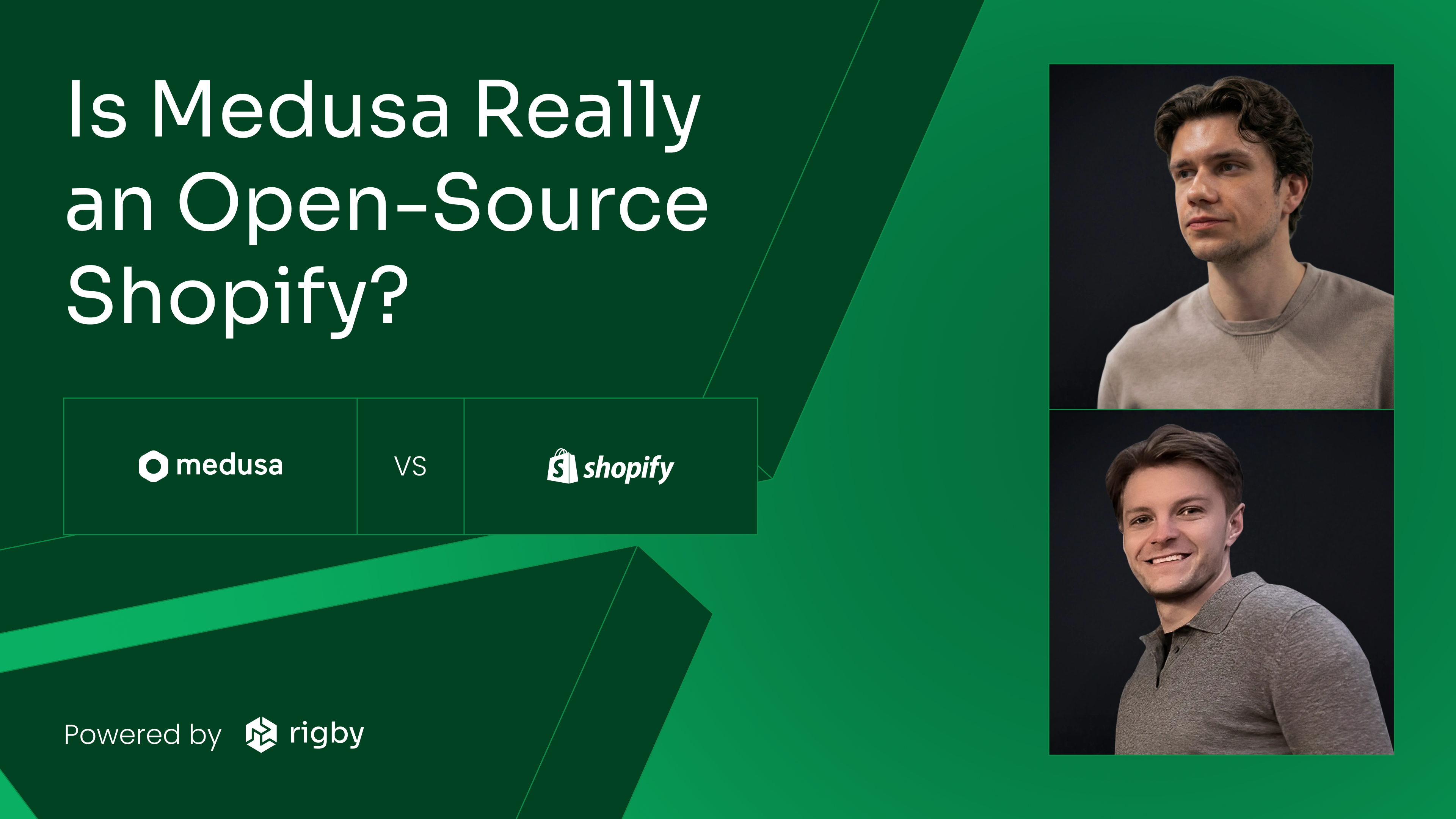
In this first episode of the Rigby Podcast, Jacob Zbąski (CEO) and Greg Tomaka (CTO) open up about the real story behind Rigby – how a small team building WordPress and WooCommerce stores ended up specializing in complex, custom marketplaces built on Medusa.js.
They talk honestly about the breaking points of monolithic eCommerce platforms, the pain of maintaining plugin-based systems, and the moment they realized headless architecture was the only way forward.
The conversation also dives into why Rigby chose deep specialization over “working with everything”, when Medusa is not the right choice, and how saying “no” to certain projects became a long-term advantage for the company, the team, and their clients.
This episode is the start of our new format – sharing internal discussions, lessons learned, and practical insights from years of building custom eCommerce and marketplace platforms.
Key insights
You’ll hear how Jacob and Greg:
- Discovered Medusa.js almost by accident.
- Why betting on an early-stage open-source technology was both risky and necessary.
- What it really means to be an early adopter with no documentation, no community answers, and no shortcuts.
You can find the podcast transcription below.
Transcription
Jacob: Hello everyone, and welcome to the first Rigby Podcast. My name is Jakub, I'm the CEO of the Rigby. With me is Greg, the CTO.
Greg: Hey, everyone.
Jacob: And today, we would like to start something new with a new format. And usually we have these conversations in private. However, yeah, why Greg have we decided to record this podcast?
Greg: Yeah, so first of all, I'm really happy we are doing this and putting it out here. I think it's just beginning because we need to involve more people from our team and share the knowledge we have. I believe that is the most valuable knowledge we can share. All these discussions inside the team, discussions about real experiences in the projects, about our thoughts about technology, how it evolves. No marketing, no buzzwords, just real experience. But before we start, I think to make it all sense, we probably need to explain who we are as a company.
Jacob: Yeah, definitely. So, we at Rigby are a software development company. We specialize in eCommerce, especially custom eCommerce and marketplaces. And we are fully focused on Medusa. That's our cup of tea. And more on that a little bit later. However, we also have our own product, which is called Mercur. Mercur is an open source marketplace platform, which is built on Medusa.js. Yeah, and how would you, Greg, describe, like, you know, in your words, the Rigby?
Greg: Yeah, your description is good, of course, but I would add that it's good to describe ourselves and our company through the projects we build, and there are very different and very custom projects. I think that the craziest one is like a multi-tenant B2B2C funeral marketplace with dynamic micro store generation. It's a crazy project because it combines different concepts from complex eCommerce together in one system. So before I didn't even know that such an industry could work online, and it could be a big-scale business, and yet here it is. So I think that there are many, many cases like this that, before these clients came to us, and explain what they wanted to build. I didn't even know that platforms like this may exist, actually. So there are many others like selling tires platform, selling 3D models, service marketplace, or different types of marketplaces. The list would be quite long if I tried to name everything. But I think it's something that really defines Rigby, that we like these challenges, we like to build custom projects, and our team is used to these challenges, that's how, that's where we are in the market, that's unique about us.
Jacob: But we didn't start like this. I remember that, you know, at the beginning it was me, and you and we started with, you know, classic ones like the WordPress, PrestaShop, and, you know, everything was fine until it wasn't. And the prominent case for that is once we were doing like the eCommerce platform on WooCommerce, and the client approached us and said that, "Hey, I would like a marketplace". To say that it was impossible, it's not like, not to say anything at all. It was simply undoable. The real issue was that, you know, everything what we tried to do was whetheryou change like one thing, totally different, broke for whatever reason. You know, maintaining it, debugging it when it is like a monolith system, it was really, really pain in the ass, to be honest. So yeah, that's, that's from my point of view, something that was a breaking point for us. However, what about you, Greg?
Greg: Yeah, definitely that was one of two breaking points, I think, because before we started building Marketplace, we were at the moment, we used these monolith technologies, as you said, WooCommerce, Presta, and a bit of Magento. And yeah, it wasn't bad. We built a few stores, and they work pretty well even today. But I think we felt that developer experience might be much better because there are many dependencies between plugins, and updating this plugin. So you updated one plugin, and the second one stopped working. Then you updated the plugin, and you needed to update something in this visual site in the theme. So it was pretty hard to maintain such a system. And I remember that you often described to me like what does look like, experience from the mobile world. And yeah, you had like a strong background in this field. So it was a trigger to try to find a better developer experience.
Jacob: Exactly.
Greg: So what didn't feel right for you in those monolithic solutions?
Jacob: Yeah, sure. I mean, the issue that combining everything in one, as you said, like changing the visual part breaks the logical part, which doesn't make sense at all. It was kind of weird for me. And that was a trigger for us to look for something like, you know, headless and something that we can control. For example, a Git version, which is not so obvious when it comes to the WordPress world, for example, and to have this, like, you know, a strong separation between those systems and to be able to control them independently. So that was something that we are looking for.And as far as I remember, the first thing that we found was Sailor, right? And Sailor was great at the beginning, but we stumbled upon some issues. So do you remember what that was?
Greg: Yeah, pretty great technology, solid foundation, but not for us and not for our use cases. So we built two stores on it and the experience was honestly quite good, but it's not as extendable as Medusa. And plus it's written in Python andwe had no really experience with it. That time we simply thought that there was not any JavaScript eCommerce platform on the market. So if we had found such a platform before, we would probably have started with it right away. But yeah, at that time we just didn't know about Medusa yet. So we understood that Sailor is not flexible enough, as you said, when we wanted to build a marketplace. And it was impossible. We asked the team. Actually, I remember there was a project from a Sailor community that tried to make a marketplace from Sailor, but I believe it's not finished even today after three years because it was really challenging. So yeah, we tried to find something else. There was an option to connect Mirakl, but that wasn't our case. We had to build a standalone.
Jacob: And why was that?
Greg: Yeah, it's just a different case. We needed to build a custom standalone marketplace, and Mirakl is for big retail enterprises. When you have the traffic, you want to connect your current commerce stack to an additional part, which is a marketplace. So it was a start.
Jacob: I would say that it was especially the money-wise situations because back then our customers, the license for the Mirakl is like a couple million bucks annually. So it was not in the range of our customers back then.
Greg: Yeah, definitely. It was a case for startups. Definitely not; Mirakl wasn't a good choice. So we started to look for alternatives, and honestly, we couldn't really find any, but I don't know if you remember how somehow we found Medusa. It is, it's a pretty great story. Do you remember that?
Jacob: I remember that. And it was quite a cool evening. We were sitting in our colleague's flat. We were having some evening beers, and that's how you ordinarily typed into Google, like "open-source," "eCommerce," "JavaScript," and "GitHub," I believe. And that's when Medusa came up. back then Medusa, it wasn't that Medusa that it is right now. It was not really popular, and the version was pretty, pretty early, I would say, but it looked, you know, promising, and I remember that the day after that, we even took it for a spin. We spun it up on our local machines and fell in love with it because, as you said, this customizability, this openness, and this easy-to-follow documentation were the things that attracted us. yeah, but I think that it was quite a crazy decision back then. What do you think about it?
Greg: I wouldn't say that it was a crazy decision; the product vision looks solid even though Medusa was still very early. It was just this version, version one, at that time. But it's true that this decision to use Medusa was based more on intuition. Then, on deep analysis or some long testing, but quite quickly we became sure that this is something we want to build our project with. Yeah, the whole concept behind Medusa is that it's just a clean foundation for developers to build their own products based on it. That was something that we just, I think, looked for. Yeah, it came quite naturally to bet on the technology. It was probably more business bet because we didn't know yet if there would be clients willing to build on Medusa. From the technical side, maybe it was bad, but it didn't feel risky to me. Maybe we were too optimistic. There were, of course, some challenges in Medusa, with Medusa, and yeah, you definitely remember, right? What did you see as a downside back then?
Jacob: Back then, I was responsible for sales, and I often remember those talks with the customers or potential customers. There is integration for that; there is integration for that. Why do I have to pay to create such an integration? If I go with WooCommerce, for example, a Presta shop, there is a plugin for that, and I don't need to pay anything, maybe for the cost of the plugin. So explaining them that okay, the plugin is some third party. We don't really know what's going on underneath, or like, is it suitable for your business case? Probably not, and modifying it would be next to impossible. So there were, like, you know, hard-to-like moments to convince the client that was kind of problematic and explaining them. It was like, you know, an on-and-on discussion with every customer that approached us, and I remember that that was quite painful. So yeah, that's from, like, my sales perspective. But what about you? What was the hardest part of being the early adopter of Medusa?
Greg: Yeah, everything you mentioned, but additionally from technical side, like there were no, there were very few materials, were no documentation for everything. There were no ready answers for some problems. Like, you know, if you wanted to find a solution for some problem in WooCommerce, let's say, you just needed to Google it and there wason the Stack Overflow ready solution for that.
Jacob: And no AI back then, right?
Greg: No, back then, yeah, so it was challenging; sometimes we had to do reverse engineering to check how something works in the Medusa core, but yeah, we handled this, and it was manageable, let's say. But from a selling point of view, I would add that I don't know if you remember when we were the first in the biggest eCommerce in Poland. And we talked to people from the industry and said that we built with Medusa, and it's amazing. And I think at the time they didn't take us seriously. They were like Medusa; they had never heard about this. Okay, okay, cool, guys. But we just want to still build an old good Magento. So the popularity was very low, especially among businesspeople. Technical people sometimes said, "Yeah, yeah, I think I heard about it," but it wasn't common. Even if we were hiring people, many developers didn't know what that was, but they were like, "I checked; I would like to learn this technology with you."
Jacob: Yeah, but I would say that it was advantageous of ours when it comes to hiring people because often during the recruitment calls we have this, yeah, you have like some different technology. It looks sexy. It looks promising. I would like to check it out, and I would like to work with it. So I would say that it was our like plus or advantage compared to other software houses.
Greg: Yeah, yeah, it might be, it might be. In general, I would say that over time it was probably worth it, right?
Jacob: Yeah, that's a great question. However, back then it was 100% bad. Looking back, I'm more than happy that we decided to go that way and not be another WooCommerce or Magento company because there are plenty of them. And it comes with some drawbacks, right? For example, sometimes when the customer approached us and as we are focusing only on Medusa. Sometimes you have to say no, because Medusa is not for everyone. Maybe we'll talk about it in somefuture podcasts, why Medusa is not for everyone. However, you sometimes need to say to the customer that maybe it's not the best solution for you. Maybe you can have a look at Shopify or some different options. And it's quite painful if you think about it, because there is some deal or some business to be done, and we need to skip it. But looking in general, I think that it's great that we are focused on only one part and we are focused only on one So yeah, I would say that it was a good bet. But what about you? What do you think about it?
Greg: Definitely, yeah, I agree with you. And I don't know if you remember this LinkedIn comment, which said something like, Don't trust an agency that works only with one technology. They will not choose the best one for you. I completely disagree with that. I believe first of all, that we need to provide all information that's necessary for our client to make his decision easier. That's the first thing, but as you said, sometimes we have to say no because it's not technology, and it's not a good case for Medusa. We feel that it doesn't make sense to use this technology in some cases, especially simple ones, like B2C stores without huge traffic. So personally, I would rather not trust a company that specializes in 20 or more technologies. There are many of them. Sometimes you can find, like, on their websites, that section about logos of technologies they work with. It's like full screen, and yeah, there are often, yes. Yes, yes. So I don't believe in that. We do only Medusa.
Jacob: Like a scroll, like a carousel, right? To fit it.
Greg: And I believe we are still discovering it every day, all the time. The technology evolves fast, so even staying up to date takes time. It's challenging. So I cannot imagine if you want to be up to date with 20 technologies. It's not possible.
Jacob: If it's legacy technology, maybe that's the case, is it good to put some new projects on the legacy technology? That's a different topic.
Greg: Still, I don't believe in that. But, yeah, maybe there are some masters in all monoliths, and they think they don't need to learn about this more. I think in Medusa we can discover more and more every day. So it's beautiful about focusing on one technology—you can understand it more deeply than the competition. We just use it as one of 20 other eCommerce platforms. So it's a completely different dynamic when you have, in our case right now, 50 people on board, and they every day share their knowledge and experiences; they can share some parts of the code and discuss it. So it works amazingly, and it speeds up development at the end.
Jacob: Mm-hmm.
Greg: And yeah, this is a real advantage.
Jacob: Yeah, yeah, I would say so, definitely. Okay, I think that it's great talk. I think that plenty of insights from us, from the company, and how we approach things. So that was kind of a test. Obviously, we didn't do anything like it before. Let us know what you think about it. And yeah, thank you very much, Greg, for your cooperation.
Greg: Yeah, thanks. We need to warm up, but it's just the beginning.
Jacob: Yeah, thank you very much for your listening, and yeah, keep in touch. See you!
Greg: Thanks.